Wadi Sarga - Coptic and Greek text edited by W. E. Crum and H. I. Bell with an Introduction by R. Campbell Thompson
- Date:
- 1922
- Reference:
- WA/HMM/CM/Sal/52/66
Licence: Public Domain Mark
Credit: Wadi Sarga - Coptic and Greek text edited by W. E. Crum and H. I. Bell with an Introduction by R. Campbell Thompson. Source: Wellcome Collection.
59/264 (page 31)
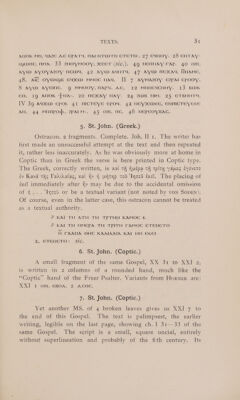
![ANOK MN, CA2G AE EPATY, MALNT@TN ETETN-. 27 G4NHY. 28 ENTAY- ance, AMA. 33 ezwOYyMOOY, XEET (Sic.). 4g NENNAY TAP. 40 O71. AY@ AVOYALOY NCW4, 42 AY AGNTA, 47 AY@M MEXAG, NNAME. 48. AIC OY@MaB Eaxa@ mmoc nad Il 7 AyMAZOY E2pAl Gpooy. 8 Ay@ AYEING. g MMOOY, MAPX. AG. 12 MNINGUCNHY. 13 BOK 60. I9 ANOK -+NA-. 20 NEXAY NAY. 24 2WB NIM. 25 ETBHHTS. IV 39 Aaxw Epol 41 MICTEYE Epod. 42 NEYXWMoE, ENNICTEY ECE AN. 44 MNTPOd., 2PAIM-. 45 Om. NE, 46 NEPEOYBAC. 5. St. John. (Greek.) Ostracon. 2 fragments. Complete. Joh. II 1.. The writer has first made an unsuccessful attempt at the text and then repeated it, rather less inaccurately. As he was obviously more at home in Coptic. than .in,<Greek the verse is here printed in ‘Coptic type. The Greek, correctly written, is xat tH féea tH telty yapog eyeveto 2y Kava cig Todtkatac, xt qv @ pytqo to0 Iycotd éxet. The placing of _ézst immediately after 4» may be due to the accidental omission of 4... Iced or be a textual variant (not noted by von SopEn). Of course, even in the latter case, this ostracon cannot-be treated as a textual authority. | P KAT TH ATH TH TPTHH KAMOC K P KAL TH HMEPA TH TPITH TFAMOC ETENETO NN PAANA OHC KAAIAAIA KAL HI GRKEI 2. ETENETO: Sic. 6. St. John. (Coptic.) A small. fragment of the; same Gospel, XX: 3a to X XI 2. is written in 2 columns of a rounded hand, much like the “Coptic” hand of the Freer Psalter. Variants from Horner. are: XXI 1 om. EBOA. 2 AENE. 7. St. John. (Coptic.) Yet another MS. of 4 broken leaves gives us XX] 7 to tive end: 01° this Gospel. he text: is palimrpsest,- the earlier writing, legible on the last page, showing ch. 1 31-33 of the same. Gospel.: The script is a small, square uncial, entirely without superlineation and probably of the 6th century. Its](https://iiif.wellcomecollection.org/image/b33159324_0059.jp2/full/800%2C/0/default.jpg)