Wadi Sarga - Coptic and Greek text edited by W. E. Crum and H. I. Bell with an Introduction by R. Campbell Thompson
- Date:
- 1922
- Reference:
- WA/HMM/CM/Sal/52/66
Licence: Public Domain Mark
Credit: Wadi Sarga - Coptic and Greek text edited by W. E. Crum and H. I. Bell with an Introduction by R. Campbell Thompson. Source: Wellcome Collection.
71/264 (page 43)
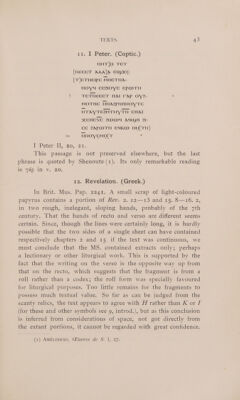
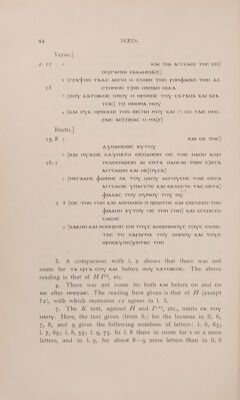
![ri, 1 Peter. (Coptic.) NHTJN TET [NGEET AAAJA EUXE [rlerneipe mneTNA- NOY4 CEZlO0yE EPMWTN 5 TETNGEET MAI rap OYye- : MOTNE NNAZPNINOYTE NTAYTEMTHY TH EnAi xENEXC 2WW4 AGM 2I- CE 2APMTN E4KW NH[TN] 10 «= NNOYCMO[T ’ P Petér-tl-20; 21% This -passagé is “not. preserved elsewhere, -but the . last phrase is quoted by Shenoute (1). Its only remarkable reading Is. a0 I Vv. 20. 12. Revelation. (Greek.) In Brit. Mus. Pap. 2241. A small scrap of light-coloured papyrus contains a portion of Rey. 2. 12—13 and 15. 8—16. 2, in two rough, inelegant, sloping hands, probably of the 7th century. That the hands of recto and verso are different seems certain. Since, though the lines were certainly long, it is hardly possible that the two sides of a single sheet can have contained respectively chapters 2 and 15 if the text was continuous, we must conclude that the MS. contained extracts only; perhaps a lectionary or other liturgical work. This is supported by the fact that the writing on the verso is the opposite way up from that on the recto, which suggests that the fragment is from a roll rather than a codex; the roll form was specially favoured for liturgical purposes. Too little remains for the fragments to possess much textual value. So far as can be judged from the scanty relics, the text appears to agree with H rather than K or [ (for these and other symbols see g, introd.), but as this conclusion is inferred from considerations of space, not got directly from the extant portions, it cannot be regarded with great confidence. (1) AMELINEAU, Giuvres' de S. 1, 27:](https://iiif.wellcomecollection.org/image/b33159324_0071.jp2/full/800%2C/0/default.jpg)