Wadi Sarga - Coptic and Greek text edited by W. E. Crum and H. I. Bell with an Introduction by R. Campbell Thompson
- Date:
- 1922
- Reference:
- WA/HMM/CM/Sal/52/66
Licence: Public Domain Mark
Credit: Wadi Sarga - Coptic and Greek text edited by W. E. Crum and H. I. Bell with an Introduction by R. Campbell Thompson. Source: Wellcome Collection.
74/264 (page 46)
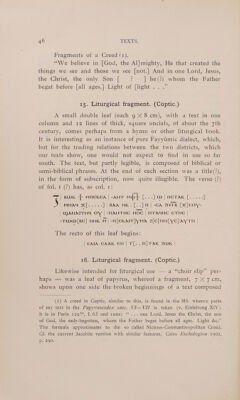
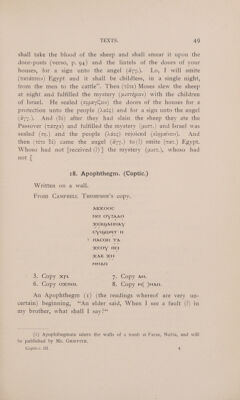
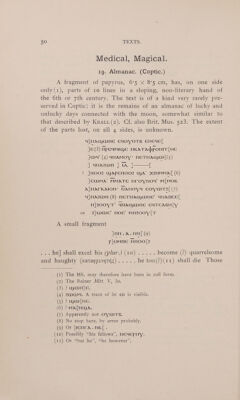
![Fragments of a Creed (1). “We believe in [God, the Al]mighty, He that created the things we see and those we see [not.] And in one Lord, Jesus, the Christ, the only.Son [ ¢. | he(?) whom. the Father begat before» all ages: |SlLightvof ([lighte 5~ 15. Liturgical fragment. (Coptic.) A smaJl double leaf (each 9 X 8 cm), with a text in one column and 12 lines of thick, square uncials, of about the 7th century, comes perhaps from a hymn or other liturgical book. It is interesting as an instance of pure Fayytimic dialect, which, but for the trading relations between the two districts, which our texts show, one would not expect to find in use so far south. The text, but partly legible, is composed of biblical or semi-biblical phrases. At the end of each section was a title(?), in the form of subscription, now quite illegible. The verso (?) OielOlniat | ahas jase COL 1. a7 | BK -} MMEKEA | -AHT mp} [-..]@|neTAK [..... ] POND NG ee Peers ]| BAA NK.[..] | -GA 2HTB [x]Eeoy- “@MANAZTHA OY | -NAHTHE noe | WraAane ETNE | -T@ [BE] NHK M|-M[EKAIT]YMA 2[E]NOLYC]AYTH | The recto of this leaf begins: | GAIA GAAK EN | TL. . NJ TAK 20K 16. Liturgical fragment. (Coptic.) Likewise intended for liturgical use — a ‘choir slip” per- haps — was a leaf of papyrus, whereof a fragment, 7 X 7 cm, shows upon one side the broken beginnings of a text composed (1) A creed in Coptic, similar to this, is found in the MS. whence parts of my text in the Papyruscodex saec. VI—VII is taken (vy. Einleitung XIV). iis-ihsbraris 12979. (265 “andoeruns: *..... one Lord, Jesus. the, Christ, the-son of God, the only-begotten, whom the Father begat before all ages. Light &c.” The formula approximates to the so called Nicaeno-Constantinopolitan Creed. Cf. the current Jacobite version with similar features, Cairo Euchologion 1902, p. 290.](https://iiif.wellcomecollection.org/image/b33159324_0074.jp2/full/800%2C/0/default.jpg)