Observations on certain parts of the animal oeconomy : inclusive of several papers from the Philosophical transactions, etc. ; Treatise on the natural history and diseases of the human teeth : explaining their structure, use, formation, growth, and diseases : in two parts / by John Hunter.
- John Hunter
- Date:
- 1839-1840
Licence: Public Domain Mark
Credit: Observations on certain parts of the animal oeconomy : inclusive of several papers from the Philosophical transactions, etc. ; Treatise on the natural history and diseases of the human teeth : explaining their structure, use, formation, growth, and diseases : in two parts / by John Hunter. Source: Wellcome Collection.
Provider: This material has been provided by the University of Massachusetts Medical School, Lamar Soutter Library, through the Medical Heritage Library. The original may be consulted at the Lamar Soutter Library at the University of Massachusetts Medical School.
32/616 page 28
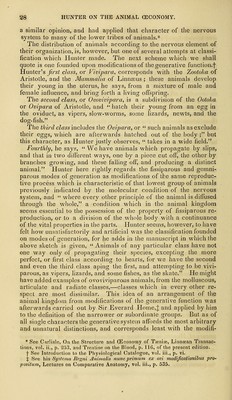
![a similar opinion, and had applied that character of the nervous system to many of the lower tribes of animals.* The distribution of animals according to the nervous element of their organization, is, however, but one of several attempts at classi- fication which Hunter made. The next scheme which we shall quote is one founded upon modifications of the generative function.^ Hunter's first class, or Vivipara, corresponds with the Zootoka of Aristotle, and the Mammalia of Linnaeus ; these animals develop their young in the uterus, he says, from a mixture of male and female influence, and bring forth a living offspring. The second class, or Ovovivipara, is a subdivision of the Ootoka or Ovipara of Aristotle, and hatch their young from an egg in the oviduct, as vipers, slow-worms, some lizards, newts, and the dog-fish. The third class includes the Ovipara, or such animals as exclude their eggs, which are afterwards hatched out of the body ; but this character, as Hunter justly observes, takes in a wide field. Fourthly, he says, We have animals which propagate by slips, and that in two different ways, one by a piece cut off, the other by branches growing, and these falling of]', and producing a distinct animal. Hunter here rightly regards the fissiparous and gemni- parous modes of generation as modifications of the same reproduc- tive process which is characteristic of that lowest group of animals previously indicated by the molecular condition of the nervous system, and where every other principle of the animal is diffused through the whole, a condition which in the animal kingdom seems essential to the possession of the property of fissiparous re- production, or to a division of the whole body with a continuance of the vital properties in the parts. Hunter seems, however, to have felt how unsatisfactorily and artificial was the classification founded on modes of generation, for he adds in the manuscript in which the above sketch is given, Animals of any particular class have not one way only of propagating their species, excepting the more perfect, or first class according to hearts, for we have the second and even the third class aping the first, and attempting to be vivi- parous, as vipers, lizards, and some fishes, as the skate. He might have added examples of ovoviviparous animals, from the molluscous, articulate and radiate classes,—classes which in every other re- spect are most dissimilar. This idea of an arrangement of the animal kingdom from modifications of the generative function was afterwards carried out by Sir Everard Home,J and applied by him to the definition of the narrower or subordinate groups. But as of all single characters the generative system affords the most, arbitrary and unnatural distinctions, and corresponds least with the modifi- * See Carlisle, On the Structure and CEconomy of Taeniae, Linnaean Transac- tions, vol. ii., p. 253, and Treatise on the Blood, p. 116, of the present edition. f See Introduction to the Physiological Catalogue, vol. iii., p. vi. % See his Systema Regni Jinimalis nunc primum ex ovi modificationibus pro- posilum, Lectures on Comparative Anatomy, vol. iii., p. 535.](https://iiif.wellcomecollection.org/image/b21197635_0032.jp2/full/800%2C/0/default.jpg)