Bibliography of the more important contributions to American economic entomology.
- Bureau of Entomology
- Date:
- 1889-1905
Licence: In copyright
Credit: Bibliography of the more important contributions to American economic entomology. Source: Wellcome Collection.
63/466 page 61
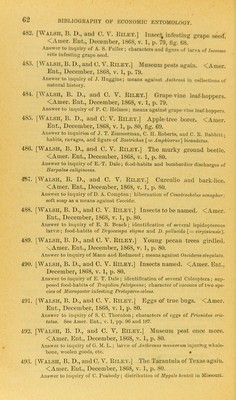
![473. I Walsh, B. D., aud C. V. Riley.] The hellgrainmite fly. <Amer. Ent., Decemb'fer, 18G8, v. 1, pp. Gl-62, figs. 5G-57. Habits of Corijdalus cornutus; figures the larva, pupa, and imago; descrip- tion and figure of the eggs of Belostoma americanum mistaken for those of Corydalua. 474. [Walsh, B. D., and 0. V. Riley.] The periodical Cicada. <Amer, Ent., December, 18G8, v. 1, pp. 63-72, figs. 58-64. Extract: <Op. cit., Jane, 1869, v. 1, p. 202. Characterization of the 13-year brood of Cicada as a new species, C. [= Tibicen} tredecim; dimorphism of the same and of C. [= T. ] aepteiidecim; seasons, nat- ural history, transformations, enemies, sting, and injuries of these species; chronological history of their several known broods; figures the several stages of C. [= T.] sepiendeoim, the towers made by the pupa and twigs with eggs. 475. [Walsh, B. D., and 0. V. Riley.] The hateful or Colorado grass- hopper, Caloptenus spretus, Uhler and Walsh. <Amer. Ent., December, 1868, v. 1, pp. 73-7Q, fig. 65. Comparative characters and figures of Caloptenus spretua and C. femur-ruhrum; native habitat, migrations, distribution, and ravages of the former; harm- lessness of its second generation in the Mississippi Valley as compared with the first generation; improbability that it will ever become a permanent resident in that region. ^ 476. [Walsh, B. D., and C. V. Riley.] The twig-girdler, Oneideres cingtilatus, Say. <Amer. Ent., December, 1868, v. 1, pp. 76- 77, fig. 66. Oviposition and food habits of Ondderes cmgiilata; figure of imago and of amputated twig. 477. [Walsh, B. D., and C. V. Riley.] An Ichneumon fly mistaken for a wasp. <Amer. Ent., December, 1868, v. 1, p. 77. Review of paper in Christian Advocate on “The stiletto wasp”; Pimpla [—Thalessa'] atrata probably mistaken for a wasp. 478. [Walsh, B. D., and C. V. Riley.] A plant growing out of an insect. <Amer. Ent., December, 1868, v. 1, p. 77. See Nos. 332, 403, 436; extract from Sedalia Press, with comments; larvm of Lachnosterna fusca infested with Cordyceps; larvte supposed to have eaten poisonous seed, which has germinated after killing the larvaj; sowing the seed as a means against the larvm. 479. [Walsh, B. D., and C. V. Riley.] On our table. <Amer. Ent., December, 1868, v. 1, p. 78. Notices of The butterflies of North America by W. H. Edwards.—The Cana- dian Entomologist.—Guido to the study of insects by A. S. Packard, jr. 480. [Walsh, B. D., aud C. V. Riley.] Eggs of the white-marked tussock moth. <Amer. Ent., December, 1868, v. 1, p. 79, fig. 67. Answer to inquiry of J. M. Hannah; characters of egg and larva of Orgyia leucostigma •, sexual diiferouces; parasites; figure of the larva. 481. [Walsh, B. D., and C. V. Riley.] Currant borers. <Amer. Ent., December, 1868, v. 1, p. 79. Vuswcr to inquiry of B. N. Mo'Kinstry; moans against Trochilium\_ — /Ege- ria] lipuUformis, T. [_= Alcalh(e'\ caiulatam, aud Psenoeenis anpernotatus.](https://iiif.wellcomecollection.org/image/b24873214_0063.jp2/full/800%2C/0/default.jpg)




 No text description is available for this image
 No text description is available for this image
 No text description is available for this image