Modified cinchona alkaloids. Pt. 1, Apoquinine and apoquinidine / by T.A. Henry and W. Solomon.
- Thomas Anderson Henry
- Date:
- [1934]
Licence: Public Domain Mark
Credit: Modified cinchona alkaloids. Pt. 1, Apoquinine and apoquinidine / by T.A. Henry and W. Solomon. Source: Wellcome Collection.
9/12 page 1929
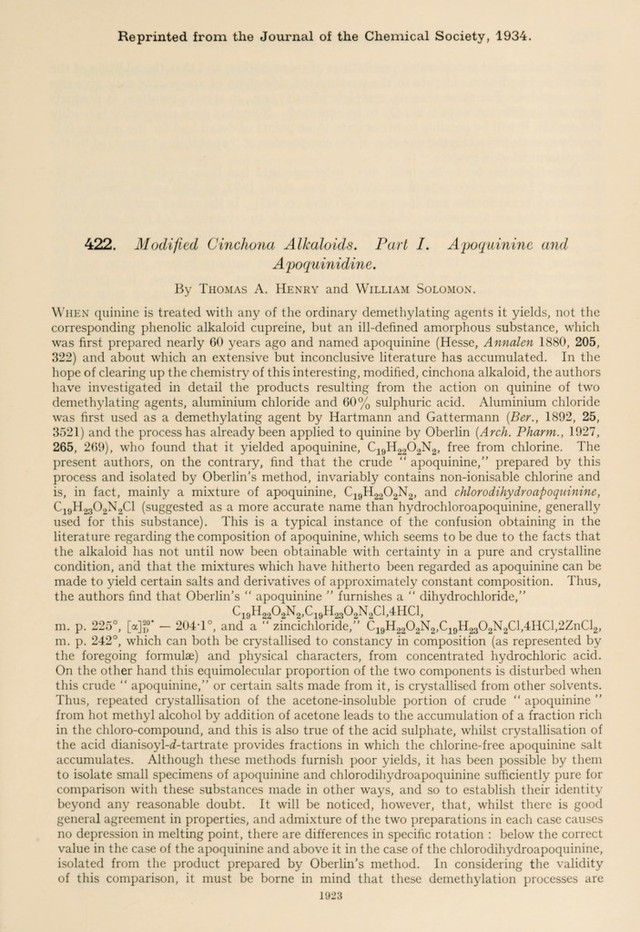
![The amount of alkaloid left in the final carbonated liquors was negligible. The crude apoquin- idine, after treatment with dry acetone to remove inorganic matter, was dissolved in alcohol, neutralised with hydrochloric acid, the solution taken to dryness at 100° in a vacuum, and the residue crystallised from boiling alcohol. Two recrystallisations gave a 30% yield of pure fsoapoquinidine hydrochloride. The mother-liquors from this salt, on concentration, deposit crops of a mixture of iso- apoquinidine hydrochloride with the hydrochloride of a dextrorotatory phenolic base, which has proved difficult to isolate in a pure state and is still under investigation. For the reasons already given (p. 1925), the name apoquinidine is reserved for this substance. iso Apoquinidine, prepared from the pure hydrochloride by solution in excess of aqueous sodium hydroxide, precipitation of the base with carbon dioxide, and solution in dry alcohol to remove inorganic impurities, crystallises from alcohol in colourless hexagomilprisms, m. p. 245° (no dccomp.), has [a]™ + 25-6° (c = 0-78 in iV/10-sulphuric acid) or —12-6° (c = 1 in alcohol), and loses 16-8% at 120° in a vacuum (Found : C, 73-3; H, 7T ; N, 9-0. C19H2202N2 requires C, 73-5; H, 7-2; N, 9-0%). The hydrochloride crystallises from alcohol in rosettes of colourless needles, m. p. 255°, [a]if — 40-2°, and is sparingly soluble in alcohol (1 in 75 c.c. cold, or 1 in 10 c.c. boiling) or water : the aqueous solution is lemon-yellow in colour. The salt shows no appreciable absorp¬ tion of hydrogen in presence of palladium or platinic oxide as catalysts (Found : C, 65*8; H, 6-7; N, 7-9; Cl, 10-9. C10H22O2N2,HC1 requires C, 65-75; H, 6-7; N, 8-1; Cl, 10-2%). The hydrobromide forms colourless needles from alcohol, m. p. 252°, [a]^° — 35-8°. The dihydrobromide crystallises from boiling alcohol (1 g. in 85 c.c.) in yellowish rectangular prisms, which are anhydrous, m. p. 280°, [a]p° + 18-6° (Found : C, 48-6; H, 5-2; N, 5-9; Br, 33-8. C19H2202N2,2HBr requires C, 48-3; H, 5-1; N, 5-9; Br, 33-9%). The acid sulphate is very soluble in water, but separates from boiling dry alcohol in pale yellow crystals, which intensify in colour on drying at 120° in a vacuum with a loss of 7-7%. The dry salt sinters at 220° and decomposes at 235—240°, [oc]1^0 + 17-6° (Found : C, 56-4; H, 6-4; N, 6-6; S, 7-5. C19H2202N2,H2S04 requires C, 55-8; H, 5-9; N, 6-9; S, 7-85%). The dihydrocupreidine used for the constants given in the comparative table (p. 1924) was made by demethylating specially prepared dihydroquinidine by the sulphuric acid process and was isolated in the same fashion as the apo-bases described above (yield, 62%). It was converted into the hydrochloride, the latter recrystallised till pure, and the base recovered and recrystal¬ lised from acetone. The two products had the following constants. Dihydrocupreidine base : undried substance, m. p. 170°; dried at 90° in a vacuum (loss 3%), m. p. 175°; dried at 120° in a vacuum (loss 10-5%), m. p. 185—195°. The base does not dry to constant weight; at 120° it turns yellow, [a]p° + 227-2° (c = 1-116 in alcohol). Dihydrocupreidine hydrochloride : the salt is anhydrous, m. p. 230—232°, [a]^3 + 193-9°. Jacobs and Heidelberger (/. Amer. Chem. Soc., 1919, 41, 817) state that the base softens at 170° and is completely melted at 195°, [0% + 253-4° (c = 1-422 in alcohol), and record for the hydrochloride m. p. 231—233°, [a]^° -f 194-2° (c = 0-618 in water). The authors record their thanks for much assistance in this work to E. M. Gibbs, B.Sc., and A. E. Thursby, B.Sc., and to Messrs. A. Bennett and H. C. Clarke for the micro-analyses. Wellcome Chemical Research Laboratories, London, N.W. 1. [Received, October Is/, 1934.] Printed in Great Britain by Richard Clay & Sons, Limited, Bungay, Suffolk.](https://iiif.wellcomecollection.org/image/b30629950_0009.jp2/full/800%2C/0/default.jpg)


 No text description is available for this image
 No text description is available for this image
 No text description is available for this image