The London dispensatory : containing I. The elements of pharmacy, II. The botanical description, natural history ... of the materia medica, III. The pharmaceutical preparations and compositions of the Pharmacopoeias of London, Edinburgh and Dublin the whole forming a practical synopsis of materia medica, pharmacy and therapeutics / by Anthony Todd Thomson.
- Anthony Todd Thomson
- Date:
- 1833
Licence: Public Domain Mark
Credit: The London dispensatory : containing I. The elements of pharmacy, II. The botanical description, natural history ... of the materia medica, III. The pharmaceutical preparations and compositions of the Pharmacopoeias of London, Edinburgh and Dublin the whole forming a practical synopsis of materia medica, pharmacy and therapeutics / by Anthony Todd Thomson. Source: Wellcome Collection.
29/1136 (page 9)
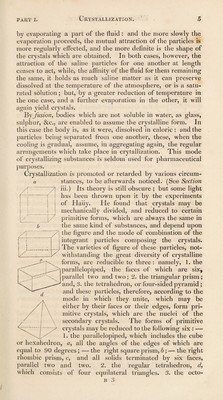
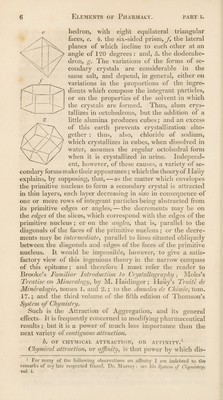
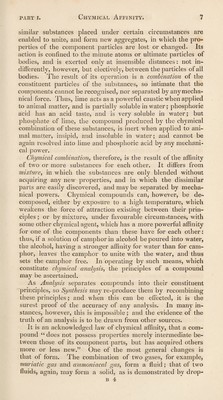
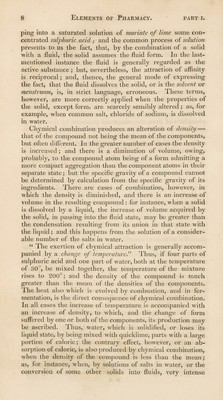
![colds greater, than any natural cold, are artificially pro¬ duced.1 The exertion of chymical affinity is influenced by various cir¬ cumstances: these, according toBerthollet, are, mass, cohesion, insolubility, specific gravity, elasticity, and inflorescence. 1. That 7iiass has a considerable share in influencing chymical affinity was first suggested by Berthollet, who states it as a canon, that combinations do not depend altogether on the attraction of affinity, but on the proportions also of the substances brought into action. Thus, if a and b form a compound, and c be a substance which has a stronger affinity for a than b has, it should be able, when mixed with a com¬ pound, to withdraw a altogether from b, if combination was regulated by affinity only: but this, he affirms, is not the case in fact; for c does not entirely combine with a, but is shared between it and b, according to the force of the affinity, and the bulk of each. This view of the subject affords a reason why, in pharmaceutical compositions, a small quantity of a substance may be added to a compound, without producing any sensible effect, although, if added in large quantity, de¬ composition would directly ensue: thence it follows, 1st, that 66 the chymical action of one substance on another must diminish as it advances to saturation ;” and, 2dly, that a de¬ composing substance ct must oppose a stronger resistance to the decomposing agent, in proportion as the decomposition proceeds, from the increase in the relative quantity of one of its ingredients to the other, which is abstracted;” and, las t]y> “ that, in estimating the relative forces of affinity in bodies, the quantities of them must be taken into account, and ought to be equal.” Objections of considerable weight have been ad¬ vanced to the opinions of Berthollet on this subject, by Pfaflf, Sir H. Davy, and others : but it is unnecessary to enter into an examination of these at the present moment; and we may only observe, that the theory of Berthollet, however plausible, is not unobjectionable; so that it is, perhaps, better for the student to regard affinity as truly elective, and that the consti¬ tuents of all compound bodies are constant. 2. Cohesion has an evident influence in opposing chymical action, and counteracting the exertion of chymical affinity. Thus, all aggregates are more slowly acted on by liquids, in which they are soluble, than when their parts are mechanically divided : and this does not happen altogether from the mere circumstance of a larger surface being presented to the fluid ; for native oxide of tin, which, in the aggregate, resists com¬ pletely the action of any acid, becomes soluble when its aggre-](https://iiif.wellcomecollection.org/image/b29318385_0029.jp2/full/800%2C/0/default.jpg)