[Report 1941] / Medical Officer of Health, Bebington Borough.
- Bebington (England). Borough Council.
- Date:
- 1941
Licence: Attribution 4.0 International (CC BY 4.0)
Credit: [Report 1941] / Medical Officer of Health, Bebington Borough. Source: Wellcome Collection.
24/40 page 22
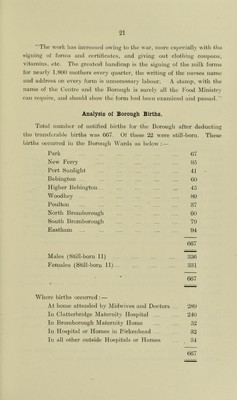
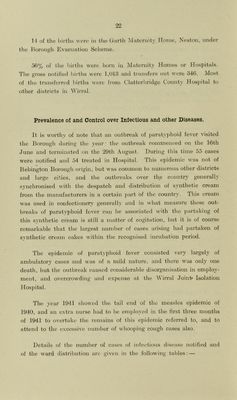
![1-1 of the birtlis were in thei Garth iNfaternity,Hoine, Neston, under the Borough Evacuation Scheme. 56% of the births were born in Maternity Hornes or Hospitals. The gross notified bii'tlis wei’e IdUS crnd transfers out were 646. IMost of the transferred births were fi'orn Clatterbridge County Hos]ntal to other districts in Wirral. Prevalence of and Control over Infectious and other Diseases. .It is worthy of note that aii outbreak of paratyphoid fever visited the Borough during the year: the outb)'eak commeiK’ed on the 16th June and terminated on the ‘29th August. During tliis time 55 cases were notified and 54 treated in Hospital. This epidemic was not of Bebington Borough origin, but was common to numerous other districts and large cities, and the outbreaks over the country generally synchronised with the despatch and distribution of synthetic cream from the manufacturers in a certain part of the country. This cream was used in confectionery generally and in what measure these out- bi'eaks of paratyphoid fever can be associated with the partaking of this synthetic cream is still a matter of cogitation, but it is of coru'se remarkable that the largest number of cases arising had partaken of synthetic cream cakes within the recognised incubation period. The epidemic of paratyphoid fever consisted very largely of ambulatory cases and was of a mild nature, and there was only one death, but the outbreak caused considerable disorganisation in employ- ment, and overcrowding and expense at the Wirral Joint* Isolation Hospital. The year 1941 showed the tail end of the measles epidemic of 1940, and an extra nurse had to be em})loyed in the first three months of 1941 to overtake the remains of this epidemic referred to, and to attend to the excessive number of whooping cough cases also. Details of the nnmher of cases of infectious disease notified and of tbe ward distribution ai'e given in the following tables: —](https://iiif.wellcomecollection.org/image/b28911167_0024.jp2/full/800%2C/0/default.jpg)
 No text description is available for this image
 No text description is available for this image
 No text description is available for this image