Diseases of the kidneys and of the spleen, hemorrhagic diseases / by H. Senator and M. Litten ; edited, with additions by James B. Herrick ; authorized translation from the German, under the editorial supervison of Alfred Stengel.
- Hermann Senator
- Date:
- 1905
Licence: Public Domain Mark
Credit: Diseases of the kidneys and of the spleen, hemorrhagic diseases / by H. Senator and M. Litten ; edited, with additions by James B. Herrick ; authorized translation from the German, under the editorial supervison of Alfred Stengel. Source: Wellcome Collection.
Provider: This material has been provided by the Francis A. Countway Library of Medicine, through the Medical Heritage Library. The original may be consulted at the Francis A. Countway Library of Medicine, Harvard Medical School.
52/858 page 46
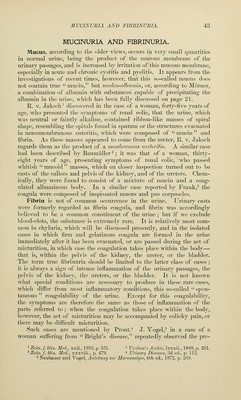
![onstrated that the casts may disappear from the urine after it has been voided, and attributes the phenomenon to digestion by the pepsin con- tained in the acid urine. [The urine to be examined for casts should be as fresh as possible. In alkaline, and particularly in decomposed, urine, casts readily disintegrate. It is often, therefore, advisable to put into the urine that is to be kept some time before examination a few grains of chloral or boric acid, a few drops of formalin or of chloro- form, etc., remembering, of course, that some of these substances, while not interfering with the examination for these organized sediments, may disturb certain chemical reactions—e. g., for sugar.—Ed.] 1. Cellular Casts.—The cells are chiefly epithelial cells from the ui*iniferous tubules, and red blood-cells. Casts rarely consist exclu- sively of leukocytes, but these elements are quite frequently found adherent to other kinds of casts. The formation of these cellular casts is not difficult to understand. Epithelial casts are due to the separation in a continuous piece of the epithelial lining of the uriniferous tubules (epithelial tubes), or to the amalgamation of the individual cells during their passage through the tubes, particularly the narrow portions, into a compact, cylindric mass. The cells may be intact or nearly so, or they may appear in various stages of granular or fatty degeneration; they may be swollen, they may still possess distinct nuclei, or the nuclei may have disappeared. So-called blood-casts are formed in a similar manner from red blood- corpuscles, the process of cohesion being probably assisted by the pres- ence of coagulated fibrin. 2. Granular casts are subdivided into the coarse granular and fine granular; the latter often present an appearance as if they had been sprinkled with a fine dust. The granules often consist of minute fat-droplets {fatty granular casts), as is shown by their refractive power and chemical reaction (osmic acid turns them black and saffranin red). Other forms appear to consist of an albuminous substance that has undergone granular degeneration. There can be no doubt that all these various forms of granular casts are in many instances derived from epithelium or epithelial casts, the cells of which have undergone granu- lar or fatty metafnorphosis either prior to their desquamation or subse- quently while in the uriniferous tubules. Lastly, it would appear that amorphous casts, when they are retained in the kidney for any length of time, may undergo granular and fatty degeneration similar to that which frequently overtakes albumin that has been cast ofP and become coagulated within the animal body. 3. Amorphous or structureless casts are again subdivided ac- cording to their appearance into (a) hyaline casts, also called colloid, vitreous, and fibrin casts; and (b) waxy casts. (a) Hyaline casts are pale and translucent; their surface is uni- formly homogeneous or striated or fibrillar in appearance. Owing to their extreme pallor and to their transparency they are often detected with*great difficulty, and sometimes can be recognized only by the pres- ence of substances, such as crystals, salts, and the like, deposited on the](https://iiif.wellcomecollection.org/image/b21167886_0052.jp2/full/800%2C/0/default.jpg)


 No text description is available for this image
 No text description is available for this image
 No text description is available for this image