A systematic course of qualitative chemical analysis of inorganic and organic substances : with explanatory notes / [Henry William Schimpf].
- Schimpf, Henry W. (Henry William), 1868-
- Date:
- 1906
Licence: In copyright
Credit: A systematic course of qualitative chemical analysis of inorganic and organic substances : with explanatory notes / [Henry William Schimpf]. Source: Wellcome Collection.
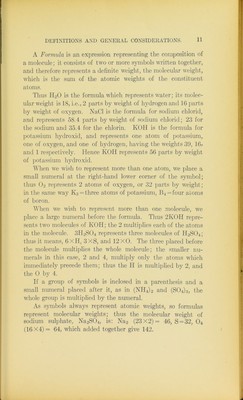
24/174 page 12
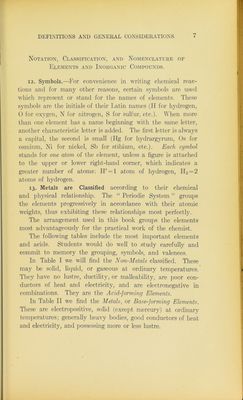
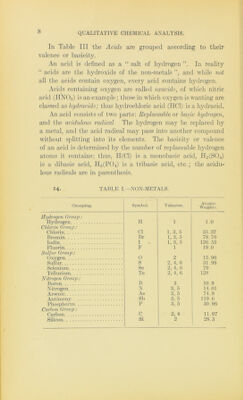
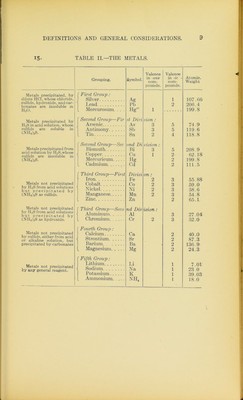
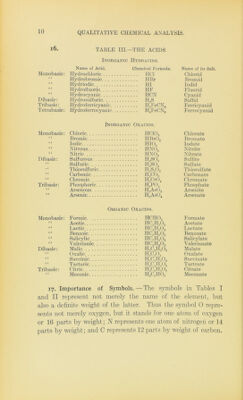
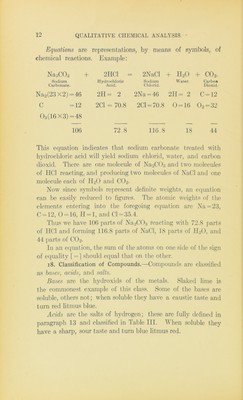
![Equations are representations, by means of symbols, of chemical reactions. Example: Na2C03 + Sodium Carbonate. Na2(23X2) =46 C =12 03(16X3)=48 2HC1 Hydrochloric Acid. 2H= 2 2C1 = 70.8 2NaCl + HoO + C02. Sodium Chlorid. Water. Carboa Dioxid. 2Na = 46 2H= 2 C = 12 2C1 = 70.8 0 = 16 02 = 32 106 72.8 116.8 18 44 This equation indicates that sodium carbonate treated with hydrochloric acid will yield sodium chlorid, water, and carbon dioxid. There are one molecule of Na2C03 and two molecules of HC1 reacting, and producing two molecules of NaCl and one molecule each of II20 and C02. Now since symbols represent definite weights, an equation can be easily reduced to figures. The atomic weights of the elements entering into the foregoing equation are Na = 23, C = 12, 0 = 16, H = l, and Cl = 35.4. Thus we have 106 parts of Na2C03 reacting with 72.8 parts of HC1 and forming 116.8 parts of NaCl, 18 parts of H20, and 44 parts of C02. In an equation, the sum of the atoms on one side of the sign of equality [ = ] should equal that on the other. 18. Classification of Compounds.—Compounds are classified as bases, acids, and salts. Bases are the hydroxids of the metals. Slaked lime is the commonest example of this class. Some of the bases are soluble, others not; when soluble they have a caustic taste and turn red litmus blue. Acids are the salts of hydrogen; these are fully defined in paragraph 13 and classified in Table III. When soluble they have a sharp, sour taste and turn blue litmus red.](https://iiif.wellcomecollection.org/image/b28062218_0024.jp2/full/800%2C/0/default.jpg)