Investigations concerning bovine tuberculosis : with special reference to diagnosis and prevention / conducted under the direction of D.E. Salmon.
- Date:
- 1894
Licence: Public Domain Mark
Credit: Investigations concerning bovine tuberculosis : with special reference to diagnosis and prevention / conducted under the direction of D.E. Salmon. Source: Wellcome Collection.
23/196 page 19
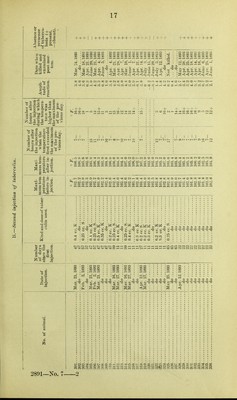
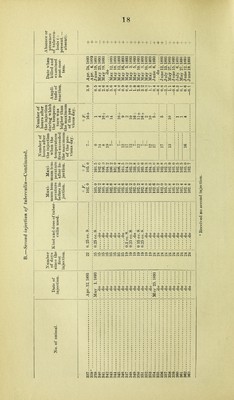
![Table A gives the result of the first injections; The absence or pres- ence of a rea(ition supported by the absence or presence of tuberculosis is so clear in 50 of the 60 animals examined post-mortem that they require no special attention. This leaves 10 animals of more doubtful character, which we will consider in order (see pp. 31-58 for complete notes): No. 305.—The maximum temperature after injection, which is 102.8° F., is not suf- ficiently high, although it is 1° F. above the maximum temperature previous to injection, to pass as a reaction in a herd of 63 cattle among which 1§ gave a max- imum temperature of 102.8° F. or more before injection. Neitlier is the elevation in the temperature after injection over and above the maximum temperature before injection (only three hours) of sufficient duration to be regarded as a reaction. Hence the absence of tuberculosis in this animal was properly indicated l>y the tuberculin injection. No. 319.—Failed to give a reaction and on post-mortem examination was found tuberculous. The tuberculous foci were small, largely calcareous, and the surround- ing tissue free from recent infiltration. No. 320.—Gave a low reaction in the absence of tuberaulosis. The animal is a heifer, which had been served by the bull every three Aveeks for five or six months previous to the date of conception, P'ebruary 1.5,1893, just one month before the injection. No. 321.—The highest temperature reached after injection was 103.4° F., and although this is 1.2° F. above the maximum temperature of the previous day, in con- sideration of the fact that the animal was seven manths advanced in her first preg- nancy, it is not sufficient to constitute a reaction. On post-mortem no tuberculosis was found, but the animal was affected with a liver disease. No. 322.—No reaction and tuberculosis present. The lesions are similar to those in No. 319. No. 334.—No reaction and tuberculosis present. No. 338.—No reaction and very extensive tuberculosis present. No. 340.—A decided reaction and no tuberculosis. The animal was supposed to be four months and ten days advanced in pregnancy at the time of the post-mortem examination, oue month after the tuberculin test, but in her uterus was found a fetus, about three months old, dead and partly disintegrated. No. .353.—Will have to pass as a case showing no tuberculosis on post-mortem, but giving a very low or somewhat doubtful reaction. No. 360.—No reaction and tuberculosis present. Similar to Nos. 319 and 322. A guinea pig inoculated died from tuberculosis in two months. Thus we have 52 instances out of 60 in which the presence or absence of tuberculosis was correctly indicated by the use of tuberculin as a diagnostic agent, giving a general average of 86f ]ier cent. It is questionable whether the absence of reactions in cases Nos. 319, 322, and 360 should have much weight. They must, indeed, be ranked as failures, but they were iu all probability stationary cases of disease, dangerous neither to themselves nor other cattle. It is also interesting to note that the two animals without tuberculosis, which must be regarded as having given a reaction, Nos. 320 and 353, show a feebler reaction, which commenced at a later hour and was of shorter duration than the reaction in any animal decidedly tuberculous. The standard of what should constitute a reaction could conveniently be raised high enough for the herd to exclude these two cases from the number of animals giving a reaction without increasing the number of animals found tuberculous without a reaction.](https://iiif.wellcomecollection.org/image/b21783111_0023.jp2/full/800%2C/0/default.jpg)