Investigations concerning bovine tuberculosis : with special reference to diagnosis and prevention / conducted under the direction of D.E. Salmon.
- Date:
- 1894
Licence: Public Domain Mark
Credit: Investigations concerning bovine tuberculosis : with special reference to diagnosis and prevention / conducted under the direction of D.E. Salmon. Source: Wellcome Collection.
61/196 page 57
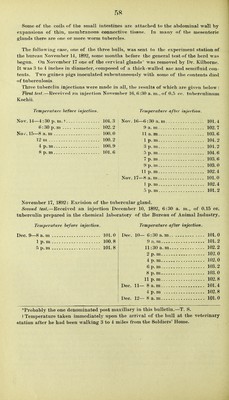
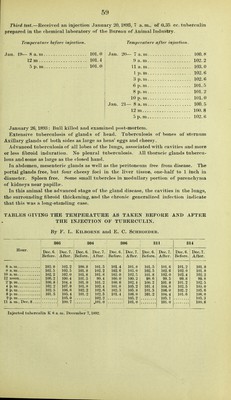
![^h/o^s(/.—Thorax: In the caudal lobes of both lungs there are three tubercnloua foci: (1) In the left caudal lobe, about 1 inch from caudal extremity, is a collection of two or three caseous, quite soft foci, the whole about one-half inch in diameter, inclosed in more or less connective tissue, and with pori])hery free from recent infil- tration. (2) Exactly corresponding in position to the ijreceding focus is one in the right caudal lobe, consisting of a soft, cheesy mass inclosed in a capsule. (3) In the left caudal lobe there is a second focus situated near median border of lobe on its dorsal aspect and about 3 or 4 inches from the caudal tip of lobe. This focus, 1| or 2 inches in diameter, on first cutting into it, appeared as a very recent infiltration. The almost normal lung tissue is studded with an immense number of miliary tubercles. On closer examination a contiguous focus of small caseous masses is found, and a small dilated air tube choked with caseous material in communica- tion with this region. The large posterior mediastinal gland contains three foci about one-fourth inch in diameter. These appear as grayish, gelatinous-looking masses projecting above the cut surface and containing some yellowish gritty particles. One of the other glands of this series contains two small foci of the same character. Brouchial gland at the root of left bronchus contains about six similar foci. The glands at root of right bronchus, the one a t the bifurcation, and the one at the root of the right supernumerary bronchus contain each a single similar focus. Three mesenteric glands contain each several small, firm, yellow tubercles. A fourth gland is as large as a lien's egg, and on section the medullary portion is found converted into a yellowish, still firm, necrotic mass. No. 363.—Cow, seven-eighths Holstein. 9 years old. Weight, 950xiounds. Calved January 31, 1893, and has not since been served by bull; is giving milk. May 1, 1893, midnight: First injection, 0.2,5 cc. tuberculin S. Before injection, maximum temperature, 103.2*^ (6 p. m.); alter injection, reached in fourteen hours, 106° (2 p. m.). (For complete record see j). 69.) May 25,1893, midnight: Second injection, 0.25 cc. tuberculin 8. Before injection, maximum temperature, 102.8'^ (8 p. m.); after injection, 102.7° (5 p. m.). (For com- plete record see p, 73.) June 19, 1893: Killed for examination. Aaiopsy.—One of tlie retropharyngeal glands is somewhat enlarged and contains a cheesy focus from one-half to three-fourths inch in diameter. The very soft con- tents are surrounded by distinct, connective-tissue capsule. Thorax: In the large posterior mediastinal gland, which is not visibly enlarged, there is in the middle of its length along one border a region about 2 inches long which appears very nodular from the exterior and feels firm and nodular to the touch. In this mass only one distinctly tuberculous focus is found. This is about three-sixteenths inch in diameter, firm, yellowish, and projecting markedly above the cut surface. One other minute yellowish focus discovered in this gland. In oneiother mediastinal gland there is some firm, cicatricial tissue in the cortex indica- tive of healed tuberculosis. In the gland situated on the dorsal aspect of the trachea, near the right supernumerary bronchus, there is a similar circumscribed mass of very tine nodular tissue and a minute yellowish tubercle. The right ventral and principal lobes are tirmly adherent to the diaphragm by means of deli- cate connective-tissue expansions. Similar slight attachments are found between pericardium and diaphragm and pericardium and the smaller lobes. Abdomen: Over the cephalic half of the convex surface of the liver there are a number of old, fibrous adhesions attaching the anterior to cephalic lobe and the diaphragm. In the same lobe are several regions of yellowish infiltration, ])robably of embolic origin and due to parasites.](https://iiif.wellcomecollection.org/image/b21783111_0061.jp2/full/800%2C/0/default.jpg)