Outlines of lectures on physiology : with an introductory chapter on general biology, and an appendix containing laboratory exercises in practical physiology / by T. Wesley Mills.
- T. Wesley Mills
- Date:
- 1886
Licence: Public Domain Mark
Credit: Outlines of lectures on physiology : with an introductory chapter on general biology, and an appendix containing laboratory exercises in practical physiology / by T. Wesley Mills. Source: Wellcome Collection.
Provider: This material has been provided by the Augustus C. Long Health Sciences Library at Columbia University and Columbia University Libraries/Information Services, through the Medical Heritage Library. The original may be consulted at the the Augustus C. Long Health Sciences Library at Columbia University and Columbia University.
23/208 page 19
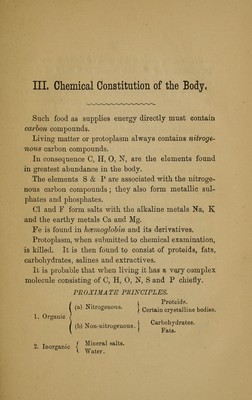
![III. Chemical Constitution of the Body, Such food as supplies energy directly must contain carbon compounds. Living matter or protoplasm always contains nitroge- nous carbon compounds. In consequence C, H, 0, N, are the elements found in greatest abundance in the body. The elements S & P are associated with the nitroge- nous carbon compounds ; they also form metallic sul- phates and phosphates. CI and F form salts with the alkaline metals Na, K and the earthy metals Ca and Mg. Fe is found in hcBinoglohin and its derivatives. Protoplasm, when submitted to chemical examination, is killed. It is then found to consist of proteids, fats, carbohydrates, salines and extractives. It is probable that when living it has a vary complex molecule consisting of C, H, 0, IST, S and P chiefly. PROXIMATE PRINCIPLES. I Proteids. (a) Nitrogenous. j ^^^^^-^ crystalline bodies. 1. Organic ,, , XT -i. ^ Carbohydrates, (b) Non-nitrogenous. ] ^ ■^ ^ ( Fats. o T • f Mineral salts. 2. Inorganic ■{ _ ^ I Water.](https://iiif.wellcomecollection.org/image/b21212843_0023.jp2/full/800%2C/0/default.jpg)