Report on an outbreak of typhoid fever at Omaha, Nebr. - (1909-1910) / by L.L. Lumsden. The water supply of Williamson, W. Va., and its relation to an epidemic of typhoid fever / by W.H. Frost.
- Leslie Leon Lumsden
- Date:
- [1910]
Licence: In copyright
Credit: Report on an outbreak of typhoid fever at Omaha, Nebr. - (1909-1910) / by L.L. Lumsden. The water supply of Williamson, W. Va., and its relation to an epidemic of typhoid fever / by W.H. Frost. Source: Wellcome Collection.
105/112 page 1
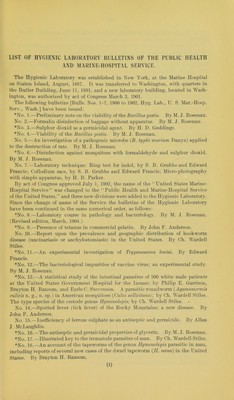
![LIST OF HYGIENIC LABORATORY BULLETINS OF THE PUBLIC HEALTH AND MARINE-HOSPITAL SERVICE. The Hygienic Laboratory was established in New York, at the Marine Hospital on Staten Island, August, 1887. It was transferred to Washington, with quarters in the Butler Building, June 11, 1891, and a new laboratory building, located in Wash- ington, was authorized by act of Congress March 3, 1901. The following bulletins [Bulls. Nos. 1-7, 1900 to 1902, Hyg. Lab., U. S. Mar.-Hosp. Serv., Wash.] have been issued: *No. 1.—Preliminary note on the viability of the Bacillus pestis. By M. J. Rosenau. No. 2.—Formalin disinfection of baggage without apparatus. By M. J. Rosenau. *No. 3.—Sulphur dioxid as a germicidal agent. By H. D. Geddings. *No. 4.—Viability of the Bacillus pestis. By M. J. Rosenau. No. 5.—An investigation of a pathogenic microbe (B. typhi murium Danyz) applied to the destruction of rats. By M. J. Rosenau. *No. 6.—Disinfection against mosquitoes with formaldehyde and sulphur dioxid. By M. J. Rosenau. No. 7.—Laboratory technique: Ring test for indol, by S. B. Grubbs and Edward Francis; Collodium sacs, by S. B. Grubbs and Edward Francis; Micro-photography with simple apparatus, by H. B. Parker. By act of Congress approved July 1, 1902, the name of the “United States Marine- Hospital Service” was changed to the “Public Health and Marine-Hospital Service of the United States,” and three new divisions were added to the Hygienic Laboratory. Since the change of name of the Service the bulletins of the Hygienic Laboratory have been continued in the same numerical order, as follows: *No. 8.—Laboratory course in pathology and bacteriology. By M. J. Rosenau. (Revised edition, March, 1904.) *No. 9.—Presence of tetanus in commercial gelatin. By John F. Anderson. No. 10.—Report upon the prevalence and geographic distribution of hookworm disease (uncinariasis or anchylostomiasis) in the United States. By Ch. Wardell Stiles. *No. 11.—An experimental investigation of Trypanosoma lewisi. By Edward Francis. *No. 12.—The bacteriological impurities of vaccine virus; an experimental study. By M. J. Rosenau. *No. 13.—A statistical study of the intestinal parasites of 500 white male patients at the United States Government Hospital for the Insane; by Philip E. Garrison, Brayton H. Ransom, and Earle C. Stevenson. A parasitic roundworm (Agamomermis culicis n. g., n. sp.) in American mosquitoes (Culex sollicitans); by Ch. Wardell Stiles. The type species of the cestode genus Hymenolepis; by Ch. Wardell Stiles. » No. 14.—Spotted fever (tick fever) of the Rocky Mountains; a new disease. By John F. Anderson. No. 15.—Inefficiency of ferrous sulphate as an antiseptic and germicide. By Allan J. McLaughlin. *No. 16.—The antiseptic and germicidal properties of glycerin. By M. J. Rosenau. *No. 17. —Illustrated key to the trematode parasites of man. By Ch. Wardell Stiles. *No. 18.—An account of the tapeworms of the genus Hymenolepis parasitic in man, including reports of several new cases of the dwarf tapeworm (H. nana) in the United States. By Brayton II. Ransom.](https://iiif.wellcomecollection.org/image/b28070793_0105.jp2/full/800%2C/0/default.jpg)