Volume 1
Catalogue of romances in the Department of Manuscripts in the British Museum.
- British Museum. Department of Manuscripts
- Date:
- 1883-1910
Licence: In copyright
Credit: Catalogue of romances in the Department of Manuscripts in the British Museum. Source: Wellcome Collection.
74/984 page 50
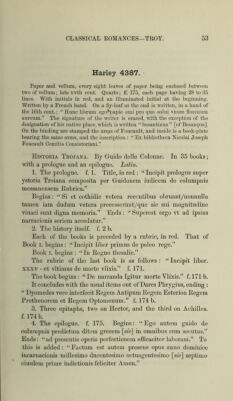
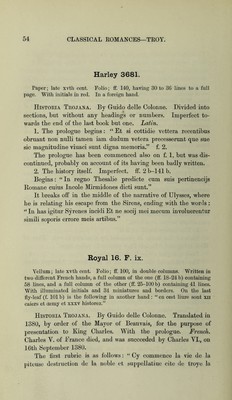
![historie stilus acuitur,” f. 140 b. The narrative of the death of Ulysses ends: “ Vlixes autem vixit annis septuaginta tribus et infeliciter est mortuus in regno suo.” After this there is a concluding section, beginning : “ Set in hoc loco dares present! operi finem fecit ”; and ending: “ Set et Pirrus interfecit Panthasilleam Eegem Priamum et eius filiam Polixenam.” f. 142 b. 3. The epilogue begins: “ Ego autem . Guido de Columpna predictum Ditem Grecuiu in omnibus sum secutus.” f, 142 b. It ends : “ ad presentis operis perfeccionem efificaciter laboraui.” To this is added : “ Factum est autem . presens opus similiter et finitum . anno dominice Incarnacionis Millesimo ducentesimo Octogesimo septimo.” f. 143. Royal 13. C. xii. ff. 6-82 b. Vellum; xvth cent. Folio; ff. 77, having 41 to 48 lines to a page. Written in England; with initials in red. Followed by: 1. Eomance of Alexander, known as Historia de Preliis. f. 83. 2. Flos Historiarum, by Haito the Armenian, ff. 110-142 b. Historia Trojana. By Guido delle Colonne. Divided into sections, but without any headings or numbers. Latin. The date of the composition (after that of the first book) is wrongly given at the end as 1297, for 1287. 1. The prologue, f. 6. Begins : “ Si et cotidie vera recentibus obuiant.” Ends: “ Superest ergo vt ad eius narracionis seriem accedant.” 2. The history itself, f. 6 b. The first section begins: “ In regno Thesalie de predicte scilicet pertinencijs romane . cuius Incole Mirmidones diet! sunt.” The last section begins: “ De narranda igitur morte Vlixis. omissis ad presens alijs presentis historie stilus autor [acuitur].” f.80b. At the end are the names, taken out of Dares Phrygius, of those principal chiefs that were slain, on the one side by Hector and Paris, and on the other by Achilles and Diomed. f. 82,](https://iiif.wellcomecollection.org/image/b29001079_0001_0074.jp2/full/800%2C/0/default.jpg)
 No text description is available for this image
 No text description is available for this image
 No text description is available for this image