Volume 1
Catalogue of romances in the Department of Manuscripts in the British Museum.
- British Museum. Department of Manuscripts
- Date:
- 1883-1910
Licence: In copyright
Credit: Catalogue of romances in the Department of Manuscripts in the British Museum. Source: Wellcome Collection.
75/984 page 51
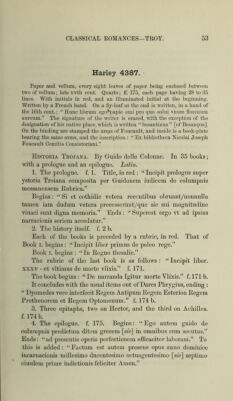
![3. Three epitaphs, two on Hector, and the third on Achilles- f. 82. 4. The epilogue, f. 82 b. Begins : “ Ego autem Guido de columpnis predictum Ditem gi’ecum in omnibus sum sequutus.” Ends : “ ad presentis operis perfeccionem efficaciter laboraui. etc.” To this is added: “Factum autem est presens opus. Anno Dominice Incarnacionis. Millesimo cc“”illF'' • xvii • eiusdem prime indiccionis felici certamine.” Colophon : “ Explicit liber de casu Troie etc. qd’ J.S.” f. 82 b. Arundel 174. Vellum; xvth cent. Octavo; ff. 145, each page having from 25 to 37 lines. Written in England. At the beginning is the signature of “ AVilliam Howarde • 1500 ”; that is to say. Belted Will, of Naworth Castle, son of the 4th Duke of Norfolk, and ancestor of the present earls of Carlisle. Histoeia Trojana. By Guido delle Colonne. In 37 books; with a prologue and an epilogue. Latin. 1. The prologue, f. 1. Title : “ Incipit prologus super his- toriam Troianam compositam per iudicem guidonem de columpna messanensem . Rubrica.” Begins : “ [LJicet cotidie vetera recentibus obuiant.” Ends : “ Superest igitur vt ad ipsius narracionis seriem accedatur.” 2. The history itself, f. 2. The first book is headed : “ Incipit liber primus de peleo and begins: “ [I]n regno Thesalie de predicte . scilicit pertinenciis Romanie cuius incole mirmidones dicti sunt.” The 37th book is headed: “liber vltimus de morte vlixis interfecti a Thelagonio filio suo.” Begins: “ De narranda igitur morte vlixis.” f. 142. The last book of the history concludes with the usual items out of Dares Phrygius, ending : “ Dyomedes vero interfecit Regem Xantipum . Begem Etherion . Regem Prothenorem . et Regem Opthomenum.” f. 145. 3. Three epitaphs, two on Hector, and the third on Achilles, f. 145. 4. The epilogue, f. 145. Begins: “ Ego autem Guydo de columpnis predictum Ditem Grecum in omnibus sum secutus.” E 2](https://iiif.wellcomecollection.org/image/b29001079_0001_0075.jp2/full/800%2C/0/default.jpg)
 No text description is available for this image
 No text description is available for this image
 No text description is available for this image