Volume 1
Catalogue of romances in the Department of Manuscripts in the British Museum.
- British Museum. Department of Manuscripts
- Date:
- 1883-1910
Licence: In copyright
Credit: Catalogue of romances in the Department of Manuscripts in the British Museum. Source: Wellcome Collection.
96/984 page 72
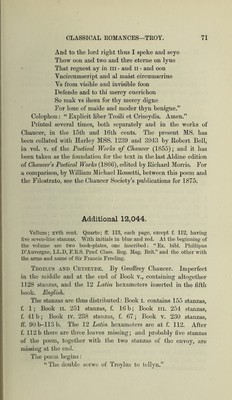
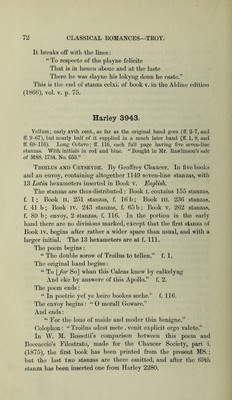
![It breaks off with the lines: “ To respecte of the playne felicite That is in heueii aboue and at the laste There he was slayne his lokyng doun he caste.” Idiis is the end of stanza cclxi. of book v. in the Aldine edition (1806), vol. V. p. 75. Harley 3943. Vellum; early xvth cent., as far as the original hand goes (ff. 2-7, and ff. 9-67), hut nearly half of it supi^lied in a much later hand (ff. 1, 8, and ff. 68-116). Long Octavo; ff. 116, each full page having five seven-line stanzas. With initials in red and blue. “ Bought in Mr. Eawlinson’s sale of MSS. 1734. No. 653.” Tkoilus and Cryseydb. By Geoffrey Chaucer. In five books and an envoy, containing altogether 1149 seven-line stanzas, with 13 Latin hexameters inserted in Book v. English. The stanzas are thus distributed: Book l. contains 155 stanzas, f. 1; Book II, 251 stanzas, f. 16 b; Book lii. 236 stanzas, f. 41 b; Book iv. 243 stanzas, f. 65 b ; Book v. 262 stanzas, f. 89 b; envoy, 2 stanzas, f. 116. In the portion in the early hand there are no divisions marked, except that the first stanza of Book IV. begins after rather a wider space than usual, and with a larger initial. The 13 hexameters are at f. 111. The poem begins: “ The double sorow of Troilus to tellen.” f. 1. The original hand begins: “ To [for So] whan this Calcas knew by calkelyng And eke by answere of this Apollo.” f. 2. The poem ends: “ In poetrie yef ye beire bookes seche.” f. 116. The envoy begins: “ 0 morall Goware.” And ends: “ For the loue of maide and moder thin benigne.” Colophon: “ Troilus adest mete . venit explicit ergo valete.” In W. M. Eossetti’s comparison between this poem and Boccaccio’s Filostrato, made for the Chaucer Society, part i, (1875), the first book has been printed from the present MS.; but the last two stanzas are there omitted, and after the 69th stanza has been inserted one from Harley 2280.](https://iiif.wellcomecollection.org/image/b29001079_0001_0096.jp2/full/800%2C/0/default.jpg)
 No text description is available for this image
 No text description is available for this image
 No text description is available for this image