Astronomy explained upon Sir Isaac Newton's principles. And made easy to those who have not studied mathematics / To which are added, a plain method of finding the distances of all the planets from the sun, by the transit of Venus over the sun's disc, in the year 1761. An account of Mr. Horrox's observation of the transit of Venus in the year 1639; and, of the distances of all the planets from the sun, as deduced from observations of the transit in the year 1761. By James Ferguson.
- James Ferguson
- Date:
- 1770
Licence: Public Domain Mark
Credit: Astronomy explained upon Sir Isaac Newton's principles. And made easy to those who have not studied mathematics / To which are added, a plain method of finding the distances of all the planets from the sun, by the transit of Venus over the sun's disc, in the year 1761. An account of Mr. Horrox's observation of the transit of Venus in the year 1639; and, of the distances of all the planets from the sun, as deduced from observations of the transit in the year 1761. By James Ferguson. Source: Wellcome Collection.
487/558 page 443
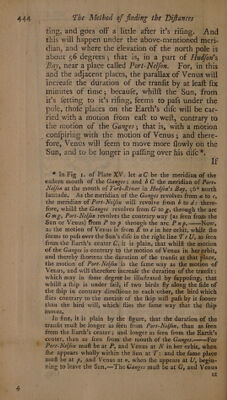
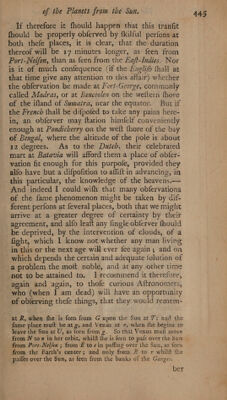
![‘ of this eclipfe caufed by Venus will, on account of the parallax, be fhortened. And from this @raw a conclufion concerning the parallax which we are in fearch, of, provided the, diameter of the known, But we cannot expect an exact compu- tation in a matter of fuch fubtility. nat We muft endeavour therefore to obtain, if pof- fible,another. obfervation, to be taken in thole places where Venus will be in. the middle of the Sun’s difc at midnight; that is, in places under hours or go.degrees weft of Londons and where Venus enters upon the Sun a little before it’s “iet- _ parallax from the Sun as feen from the Garges at g, when fhe is but juft beginning to leave the Sun.at U, as feen from the Earth’s center C. Aves Here it is plain, that the duration of the tranfit about the gmouth of the Ganges (and alfo. in the neighbouring places) willbe diminifhed by about double the quantity of Venus’s parallax from theSunat the beginning and ending of the tranfit. For Venus muft be at/£ in her orbit whem the is wkhollyupon the Sun at 7, as feen from the Farth’s center C: but at that time fhe is fhort of the Sun as feen from the Ganges at G,. by the whole quantity of her eaftern parallax from the Sun at that time, which is. the angle KET. [This angle, in fact, is only 23°; though it is reprefented much. larger in the figure,. be- ‘caufe ithe arth therein is: a: vaft deal. too big] Now,» as Venus moves at the rate of 4’ in an hour, ‘he will move 23” in & minutes 45 feconds: and, therefore, the tranfit wall be 5 “min. 45. feconds later of beginning at the banks of the Ganges than at the Earth’s center.. When the.tranfit is ending at U, as feen from the Earth’s center C, Venus will be quite clear of the Sun (by the whole quantity. of her weftern parallax from him) as feen from the Ganges, which is then at gz and this! parallax will’be' 22°”, equal to the fpace through which ‘ wala “Wenus moves in 5. minutes 30 feconds: of time: fo that the ¢ranfit will end 5-4 minutes fooncr as feen from the Ganges, -than as feen from the Harth’s center. re » Hence, the whole contraétion of the duration of the tranfit ‘time: for it is s minutes 45 feconds at the beginning, and 5 A minutes 30 feconds at the end. . —](https://iiif.wellcomecollection.org/image/b30501349_0487.jp2/full/800%2C/0/default.jpg)