Astronomy explained upon Sir Isaac Newton's principles. And made easy to those who have not studied mathematics / To which are added, a plain method of finding the distances of all the planets from the sun, by the transit of Venus over the sun's disc, in the year 1761. An account of Mr. Horrox's observation of the transit of Venus in the year 1639; and, of the distances of all the planets from the sun, as deduced from observations of the transit in the year 1761. By James Ferguson.
- James Ferguson
- Date:
- 1770
Licence: Public Domain Mark
Credit: Astronomy explained upon Sir Isaac Newton's principles. And made easy to those who have not studied mathematics / To which are added, a plain method of finding the distances of all the planets from the sun, by the transit of Venus over the sun's disc, in the year 1761. An account of Mr. Horrox's observation of the transit of Venus in the year 1639; and, of the distances of all the planets from the sun, as deduced from observations of the transit in the year 1761. By James Ferguson. Source: Wellcome Collection.
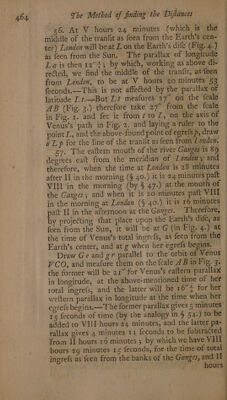
509/558 page 463
![at that time. Take thefe in your compaffes, and meature them on the fcale 4B (Fig. 3.) and you will find the parallax in longitude to be 10°23, and the parallax in latitude to be 212. 54. As Venus’s true motion on the Sun is at the rate of 4 minutes of a degree in 60 minutes of time (See N° XI. of § 31.) fay, as 4 minutes of a degree is to 60 minutes of time, fo is 10°32 of a degree to 2 minutes 41 feconds of time; which being added to VIII hours 20 minutes (becaufe this parallax is eaftward, § 49.) gives VIII hours 22 minutes 41 feconds, for the beginning of egrefs at London, as affected only by this parallax.—But, as Venus has a fouthern parallax of latitude at that time, her beginning of egrefs will be fooner; for this parallax fhortens the line of her vifible tranfit at London, add it to Venus’s latitude 9’ 43”, and the fum will be 10° 4”+; which is to be taken from the feale in Fig. x. and fet from Cto Z in Fig. 2. And then, if a line be drawn parallel to ¢/, it will ter- minate at the point p in the arc J, where Venus’s Lp in your compaffes, and fetting that extent from ¢ towards / on the central tranfit-line, you will find feconds, and there willremain VIL] hours 17 minutes den? ge the morning at London. * The reafon why the lines oLp, abd, ct, and ¢é, which are the vifible tranfits at London, the Ganges mouth, Bencoolen, is, becaufe the parallaxes in latitude are different at the times of ingrefs and egrefs, as feen from each of thefe places. The 56.8](https://iiif.wellcomecollection.org/image/b30501349_0509.jp2/full/800%2C/0/default.jpg)