Licence: In copyright
Credit: The mind of man : a text-book of psychology / by Gustav Spiller. Source: Wellcome Collection.
Provider: This material has been provided by the Royal College of Physicians of Edinburgh. The original may be consulted at the Royal College of Physicians of Edinburgh.
65/578 page 45
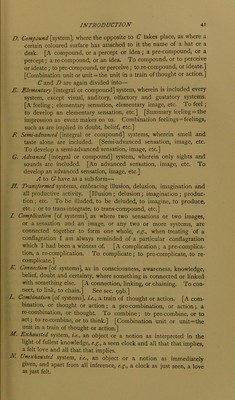
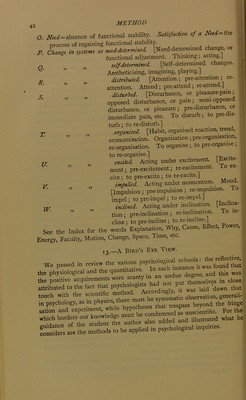
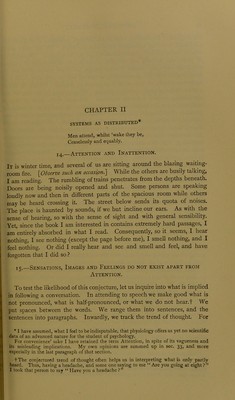
![SYSTEMS AS DISTRIBUTED* Men attend, whilst ’wake they be, Ceaselessly and equably. 14. Attention and In.a.ttention. It is winter time, and several of us are sitting around the blazing waiting- room fire. {Observe such an occasion.'] While the others are busily talking, I am reading. The rumbling of trains penetrates from the depths beneath. Doors are being noisily opened and shut. Some persons are speaking loudly now and then in different parts of the spacious room while others may be heard crossing it. The street below sends its quota of noises. The place is haunted by sounds, if we but incline our ears. As with the sense of hearing, so with the sense of sight and with general sensibility. Yet, since the book I am interested in contains extremely hard passages, I am entirely absorbed in what I read. Consequently, so it seems, I hear nothing, I see nothing (except the page before me), I smell nothing, and I feel nothing. Or did I really hear and see and smell and feel, and have forgotten that I did so ? 15.—Sensations, Images and Feelings do not exist apart from Attention. To test the likelihood of this conjecture, let us inquire into what is implied in following a conversation. In attending to speech we make good what is not pronounced, what is half-pronounced, or what we do not hear.f We put spaces between the words. We range them into sentences, and the sentences into paragraphs. Inwardly, we track the trend of thought. For * I have assumed, what I feel to be indisputable, that physiology offers as yet no scientific data of an advanced nature for the student of psychology. For convenience’ sake I have retained the term Attention, in spite of its vagueness and its misleading implications. My own opinions are summed up in sec. 33, and more especially in the last paragraph of that section. t The conjectured trend of thought often helps us in interpreting what is only partly heard. Thus, having a headache, and some one saying to me “ Are you going at eight?” I took that person to say “ Have you a headache ?”](https://iiif.wellcomecollection.org/image/b21938982_0065.jp2/full/800%2C/0/default.jpg)