Two monographs on malaria and the parasites of malarial fevers / I. Marchiafava and Bignami, II. Mannaberg.
- New Sydenham Society
- Date:
- 1894
Licence: Public Domain Mark
Credit: Two monographs on malaria and the parasites of malarial fevers / I. Marchiafava and Bignami, II. Mannaberg. Source: Wellcome Collection.
Provider: This material has been provided by The University of Leeds Library. The original may be consulted at The University of Leeds Library.
345/492 (page 301)
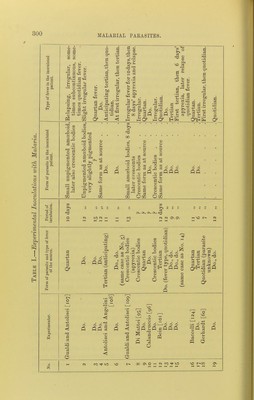
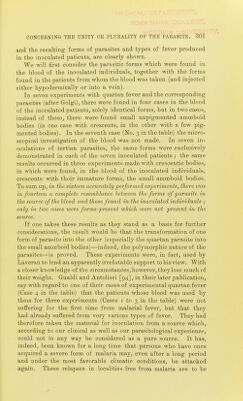
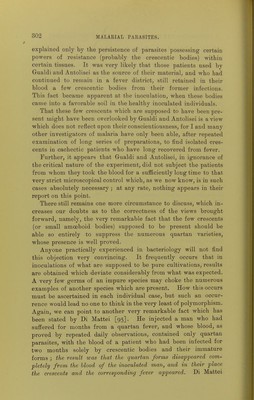
![and the resulting forms of parasites and types of fever produced in the inoculated patients, are cleai-ly shown. We will first consider the parasitic forms which were found in the blood of the inoculated individuals^ together with the forms found in the patients from whom the blood was taken (and injected either hypodermically or into a vein). In seven experiments with quartan fever and the corresponding parasites (after G-olgi), there were fouud in four cases in the blood of the inoculated patients, solely identical forms, but in two cases, instead of these, there were found small unpigmented amoeboid bodies (in one case with crescents, in the other with a few pig- mented bodies), In the seventh case (No. 3 in the table) the micro- scopical investigation of the blood was not made. In seven in- oculations of tertian parasites, the same forms were exclusively demonstrated in each of the seven inoculated patients ; the same results occurred in three experiments made with crescentic bodies, in which were found, in the blood of the inoculated individuals, crescents with their immature forms, the small amoeboid bodies. To sum up, in the sixteen accurately performed experiments, there ivas in fourteen a complete resemblance between the forms of parasite in the source of the blood and those found in the inoculated individuals ; only in two cases were forms present which were not present in the source. If one takes these results as they stand as a basis for further considerations, the result would be that the transformation of one form of parasite into the other (especially the quartan parasite into the small amoeboid bodies)—indeed, the polymorphic nature of the parasites—is proved. These experiments were, in fact, used by Laveran to lend an apparently irrefutable support to his view. With a closer knowledge of the circumstances, however, they lose much of their weight. Gualdi and Antolisei [94], in their later publication, say with regard to one of their cases of experimental quartan fever (Case 4 in the table) that the patients whose blood was used by them for three experiments (Cases i to 3 in the table) were not suffering for the first time from malarial fever, but that they had already suffered from very various types of fever. They had therefore taken the material for inoculation from a source which, according to our clinical as well as our parasitological experience, could not in any way be considered as a pure source. It has, indeed, been known for a long time that persons who have once acquired a severe form of malaria may, even after a long period and under the most favorable climatic conditions, be attacked again. These relapses in localities free from malaria are to be](https://iiif.wellcomecollection.org/image/b21514380_0345.jp2/full/800%2C/0/default.jpg)