Supplementary note to a paper entitled Researches in embryology, third series : a contribution to the physiology of cells / by Martin Barry.
- Martin Barry
- Date:
- 1841
Licence: Public Domain Mark
Credit: Supplementary note to a paper entitled Researches in embryology, third series : a contribution to the physiology of cells / by Martin Barry. Source: Wellcome Collection.
Provider: This material has been provided by The Royal College of Surgeons of England. The original may be consulted at The Royal College of Surgeons of England.
3/6
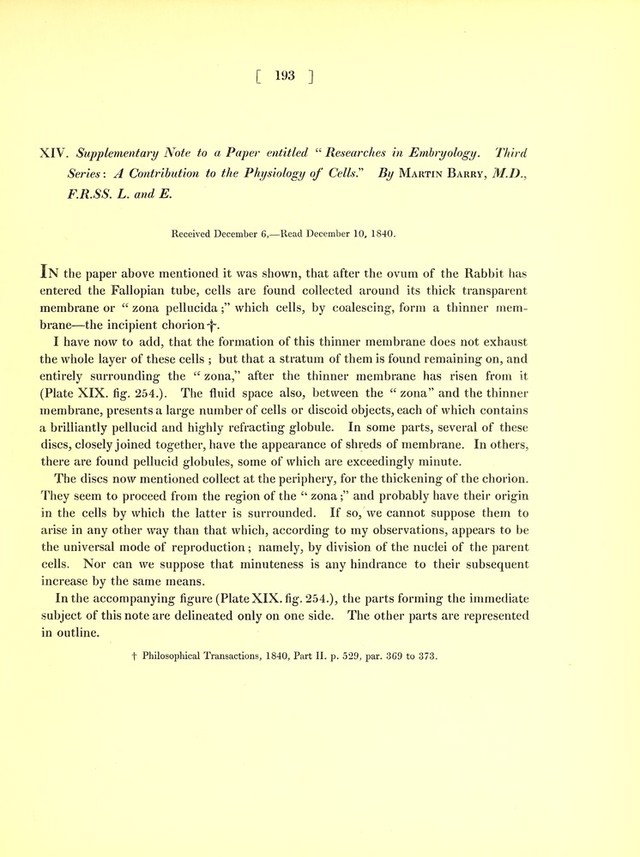
![[ 193 ] XIV. Supplementary Note to a Paper entitled “ Researches in Embryology. Third Series: A Contribution to the Physiology of Cells. By Martin Barry, M.D., F.R.SS. L. and E. Received December 6,—Read December 10, 1840. In the paper above mentioned it was shown, that after the ovum of the Rabbit has entered the Fallopian tube, cells are found collected around its thick transparent membrane or “ zona pellucidawhich cells, by coalescing, form a thinner mem- brane—the incipient chorion^. I have now to add, that the formation of this thinner membrane does not exhaust the whole layer of these cells ; but that a stratum of them is found remaining on, and entirely surrounding the “ zona,” after the thinner membrane has risen from it (Plate XIX. fig. 254.). The fluid space also, between the “ zona” and the thinner membrane, presents a large number of cells or discoid objects, each of which contains a brilliantly pellucid and highly refracting globule. In some parts, several of these discs, closely joined together, have the appearance of shreds of membrane. In others, there are found pellucid globules, some of which are exceedingly minute. The discs now mentioned collect at the periphery, for the thickening of the chorion. They seem to proceed from the region of the “ zonaand probably have their origin in the cells by which the latter is surrounded. If so, we cannot suppose them to arise in any other way than that which, according to my observations, appears to be the universal mode of reproduction; namely, by division of the nuclei of the parent cells. Nor can we suppose that minuteness is any hindrance to their subsequent increase by the same means. In the accompanying figure (Plate XIX. fig. 254.), the parts forming the immediate subject of this note are delineated only on one side. The other parts are represented in outline. f Philosophical Transactions, 1840, Part II. p. 529, par. 369 to 373.](https://iiif.wellcomecollection.org/image/b22296797_0005.jp2/full/800%2C/0/default.jpg)