The Readson Duo-Ray infra-red ray apparatus : pain, rheumatism, it just kills it / Harrods Ltd.
- Date:
- [1936?]
Licence: Public Domain Mark
Credit: The Readson Duo-Ray infra-red ray apparatus : pain, rheumatism, it just kills it / Harrods Ltd. Source: Wellcome Collection.
11/28 page 9
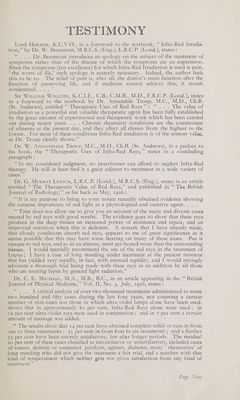
![TESTIMONY Lord Horper, K.C.V.O., in a foreword to-the textbook, “‘ Infra-Red Irradia- tion,”’ by Dr. W. Beaumont, M.R.C.S. (Eng.), L.R.C.P. (Lond.), states : _ ©... Dr. Beaumont introduces an apology on the subject of the treatment of symptoms rather than of the disease of which the symptoms are an expression. Since the symptoms (par excellence) for which Infra-Red Irradiation is used is pain, ‘the worst of ills,’ such apology is scarcely necessary. Indeed, the author feels this to be so. The relief of pain is, after all, the doctor’s main function after the function of preserving life, and if medicine cannot achieve this, it stands Sendemned., .. .” Se WimrLame Wiracox, K.C.I.E., C.B., C.M.B., M.D., F.R.C.P. (Lend.),. states in a foreword to the textbook by Dr. Annandale Troup, M.C., M.D., Ch.B. (St. Andrews), entitled “‘ Therapeutic Uses of Red Rays’’: “ ... The value of irradiation as a powerful and valuable therapeutic agent has been fully established by the great amount of experimental and therapeutic work which has been carried out during recent years. . . . Chronic rheumatic conditions are the commonest of ailments at the present day, and they affect all classes from the highest to the lowest. For most of these conditions Infra-Red irradiation is of the utmost value, as Dr. Troup clearly shows.”’ Dr. W. ANNANDALE Troup, M.C., M.D., Ch.B. (St. Andtews), in a preface to his book, the ‘“‘ Therapeutic Uses of Infra-Red Rays,’’ states in a concluding paragraph : “In my considered judgment, no practitioner can afford to neglect Infra-Red therapy. He will at least find it a great adjunct to treatment in a wide variety of eases.” De, G. Murray Levicx, L.R.C.P. (Lond.), M.R.C.S. (Eng.), states in an article entitled ‘“ The Therapeutic Value of Red Rays,’’ and published in “‘ The British Journal of Radiology,’’ as far back as May, 1926: “Tt is my purpose to bring to your notice recently obtained evidence showing the extreme importance of red light as a physiological and curative agent... . “Time does not allow me to give you an account of the many and diverse cases treated by red rays with good results. The evidence goes to show that these rays produce in the deep tissues an increased power of resistance and repair, and an improved nutrition when this is deficient. A remark that I have already made, that cloudy conditions absorb red rays, appears to me of great significance as it seems possible that this may have some bearing on many of these cases. Pus is opaque to red rays, and so in an abscess, must get heated more than the surrounding tissues. I would specially recommend the use of the red rays in the treatment of Lupus; I have a case of long standing under treatment at the present moment that has yielded very rapidly, in fact, with unusual rapidity, and I would strongly advocate a thorough trial being made with these rays as an addition by all those who ate treating lupus by general light radiation.”’ Dr. C. E. Micwaet, M.A., M.B., B.C., in an article appearing in the “‘ British Journal of Physical Medicine,’’ Vol. II, No. 3, July, 1936, states : “ ... Acritical analysis of over two thousand treatments administered to some two hundred and fifty cases during the last four years, not counting a certain number of skin cases nor those in which ultra-violet lamps alone have been used. shows that in approximately 80 per cent, Infra-Red Rays alone were used; in 12 per cent ultra-violet rays were used in conjunction ; and in 7 per cent a certain amount of massage was added. “ The results show that 14 per cent have obtained complete relief or cure in from one to three treatments ; 33 per cent in from four to six treatments ; and a further 33 per cent have been entirely satisfactory, but after longer periods. The residua] 20 per cent of these cases classified as inconclusive or unsatisfactory, included cases of cancer, definite or suspected, paralysis, agitans, diabetes, many ‘ rheumatics’ of long standing who did not give the treatment a fair trial, and a number with that kind of temperament which neither gets nor gives satisfaction from any kind of treatment.”](https://iiif.wellcomecollection.org/image/b33467584_0011.jp2/full/800%2C/0/default.jpg)
 No text description is available for this image
 No text description is available for this image
 No text description is available for this image