A treatise on human physiology : designed for the use of students and practitioners of medicine / by John C. Dalton, Jr.
- John Call Dalton
- Date:
- 1866
Licence: Public Domain Mark
Credit: A treatise on human physiology : designed for the use of students and practitioners of medicine / by John C. Dalton, Jr. Source: Wellcome Collection.
Provider: This material has been provided by the Augustus C. Long Health Sciences Library at Columbia University and Columbia University Libraries/Information Services, through the Medical Heritage Library. The original may be consulted at the the Augustus C. Long Health Sciences Library at Columbia University and Columbia University.
706/732
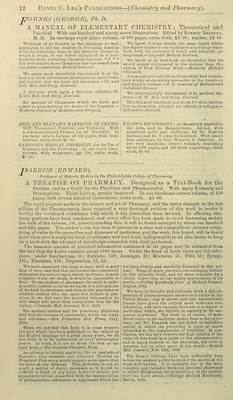
![pOWNES [GEORGE], Ph.D. A MANUAL OF ELEMENTARY CHEMISTRY; Theoretical and Practical. With one hundred and ninety-seven illustrations. Edited by E,obbrt Bridges, M. D. In one large royal 12mo. volume, of 600 pages, extra cloth, $2 00 ; leather, $2 60. We know of no treatise in the language so well calculated to aid the student in becoming familiar with the numerous facts in the intrinsic science on which it treats, or one better calculated as a text- book for those attending Chemical lectures. * f * * The best text-book on Chemistry that has issued from our pi-ess.—American Medical Journal. We again most cheerfully recommend it as the best texVbook for students in attendance upon Chem- ical lectures that we have yet examined.—III. and Ind. Med. and Surg. Journal. A first-rate work upon a first-rate subject.—St. Louis Med. and Surg. Journal. jS'o manual of Chemistry which we have met comes so near meeting the wants of the beginner. — Western -Journal of Medicine and Surgery. We know of none within the same limits which has higher claims to our confidence as a college class- book, both for accnracy of detail and scientific ar- rangement.—Augusta Medical Journal. We know of no text-book on chemistry that we would sooner recommend to the student than this edition of Prof. Fownes' work.—Montreal Medical Chronicle. A new and revised edition of one of the best elemen- tary works on chemistry accessible to the American and English student.—N. Y. Joxirnal of Medical and Collateral Science. We unhesitatingly recommend it to medical stu- dents.—N. W. Med. and Surg. Journal. This is a most excellent text-book for cla.ss instruc- tion in chemistry, whether for schools or colleges.— Silli'inan's Journal. ABEL AND BLOXAM'S HANDBOOK OF CHEMIS- TllY, Tlieoretical, Practical, and Technical. With a recommendatory Preface, by Dr. Hoffman. In one large octavo volume of t)62 pages, with illus- trations, extra cloth, $i 50. GARDINfEirS MEDICAL CHEMISTRY, for the Use of Students, and the Profession. In one royal 12mo. volume, with wood-cuts; pp. 396, extra cloth, $1 00. KWAPP'S TECHNOLOGY ; or Ohemlstry Applied to the Arts, and to Manufactures. Edited, with numerous notes and additions, by Dr. Edmund EoKALS, and Dr. Thomas Plichardso.^. With Amer- ican additions, by Prof. Walter R Johnson. la two very handsome octavo volumes, containing about 1000 pages, and 300 wood engravings, extra cloth, $6 00. pARRISH {ED WARD), Professor of Materia Medico in the Philadelphia College of Pharmacy. A TREATISE ON PHARMACY. Designed as a Text-Book for the Student, and as a Guide for the Physician and Pharmaceutist. With many Formulae and Prescriptions. Third Edition, greatly improved. In one handsome octavo volume, of 850 pages, with several hundred illustrations, extra cloth. $5 00. The rapid progress made in the science and art of Pharmacy, and the many changes in the last edition of the Pharmacopoeia have required a very thorough revision of this work to render it worthy the continued conlidence with which it has heretofore been favored. In effecting this, many portions have been condensed, and every eifort has been made to avoid increasing unduly the bulk of the volume, yet, notwithstanding this, it will be found enlarged by about one hundred and fifty pages. The author's aim has been to present in a clear and compendious manner every- thing of value to the prescriber and dispenser of medicines, and the work, it is hoped, will be found more than ever a complete book of reference and text-book, indispensable to all who desire to keep on a level with the advance of knowledge connected with tbeir profession. The immense amount of practical information condensed in its pages may be estimated from the fact that the Index contains about 4700 items. Under the head of Acids there are 312 refer- ences ; under Emplastrum, 3ti; Extracts, 159; Lozenges, 25 ; Mixtures, 55 ; Pills, 66 ; Syrups, 131; Tinctures, 138; Unguentum, 57, &c. We have examined this large volume with a good deal of care, and find that the author has completely exhausted the subject upon which he treats ; a more complete work, we think, it would be impossible to find. To the student of pharmacy the work is indis- pensable ; indeed, so far as we know, it is the only one of its kind in exi.stence, and eveu to the physician or medical student who can spare five dollars to pur- chase it, we feel sure the practical information he will obtain will more than compensate him for the outlay.—Canada Med. Journal, Nov. lS6i. The medical student and the practising physician will find the volume of inestimable worth for study and reference.—San Francisco Med. Press, July, 1S6I. When we .say that this book is in some respects the best which has been published ou the subject in the English language for a great many years, we do not wish it to be understood as very extravagant Ijraise. In truth, it is not so much the best as the only book.—The London Chemical News. An attempt to furnish anything like an analysis of Parrish's very valuable and elaborate Treatise on Practical Pharmacy would require more space than we have at our disposal. This, however, is not so much a iBatter of regret, inasmuch as it would be difiicult to think of any point, however minute and apparently trivial, connected with the manipulation of pharmaceutic substances or appliances which has not been clearly and carefully discussed in this vol- ume. Want of space prevents our enlarging further on this valuable work, and we must conclude by a simiile expression of our hearty appreciation of its merits.—Dublin Quarterly Jour, of Medical Science, August, 1861. We have in this able aud elaborate work a fair ex- position of pharmaceutical science as it exists in the United States ; and it shows that our transatlantic friends have given the subject most elaborate con- sideration, and have brought their art to a degree of perfection which, we believe, is scarcely to be sur- passed anywhere. The book is, of course, of more direct value to the medicine maker than to the physi- cian ; yet Mr. PARRtsH has not failed to introduce matter in which the prescriber is Cjuite as much interested as the compounder of remedies. In con- clusion, we can only express our high opinion of the value of this work as a guide to the pharmaceutist, and in many respects to the physician, not only ia America, but in other parts of the world.—British 3Ied. Journal, Nov. 12th, 1861. The former editions have been suflSciently long before the medical public to render the merits of the work well known. It is certainly one of the most complete and valuable works on practical pharmacy to which the student, the practitioner, or the apothe- cary can have access.—Chicago Medical Examiner, March, 1861.](https://iiif.wellcomecollection.org/image/b21224808_0706.jp2/full/800%2C/0/default.jpg)