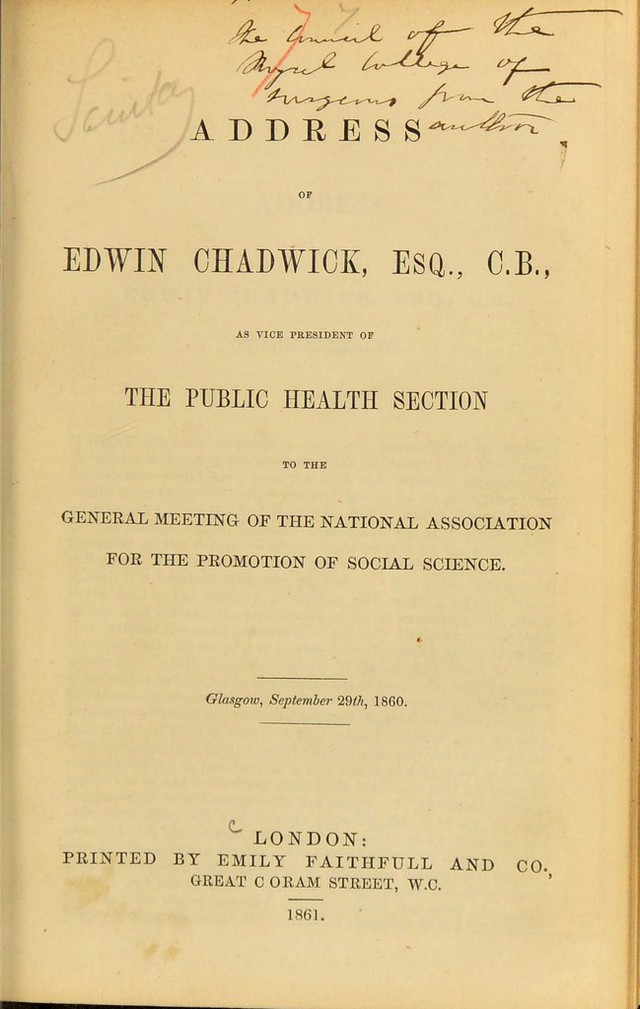
Address of Edwin Chadwick, Esq., C.B., as vice president of the Public Health Section to the General Meeting of the National Association for the Promotion of Social Science, Glasgow, September 29th, 1860.
- Edwin Chadwick
- Date:
- 1861
Licence: Public Domain Mark
Credit: Address of Edwin Chadwick, Esq., C.B., as vice president of the Public Health Section to the General Meeting of the National Association for the Promotion of Social Science, Glasgow, September 29th, 1860. Source: Wellcome Collection.
Provider: This material has been provided by The Royal College of Surgeons of England. The original may be consulted at The Royal College of Surgeons of England.
5/40 page 5
![engineers who luive conducted works in other parts of thcAVorld give siniiliir testimony. The qualities which take the lead in mining and tunnelling, take the lead in penetrating forests and clearances for colo- nisation. Volney and other French witnesses acknowledge the supe- riority of the Anglo-Saxon in this respect. The foremost labour of every kind and degree, mental as well as manual, which has supplied the waste of life and energy in our towns, has been sustained by supe- rior physical stamina, derived from those comparatively good sanitary conditions, enjoyed for generations in rural districts, which we wish to give to towns—pure air, pure water, pure and abundant food. Now, the drain upon this description of labour has been, and is, such as to weaken our defences more seriously than we have been disposed to admit. At this time, when the improvement in the implements of war requires an improved quality of hands to wield them,—though the condition of the sailor in the Royal Navy has undergone great improvement, as denoted by the death rate, which, the deaths from violence included, is little more than one-third that of the mercan- tile marine,—yet it has been a complaint of many of the commanders that the hands they now obtain, and these with difficulty, are often the very refuse of the ports. The extent of the fraudulent obtain- ment of bounties, and subsequent desertions, is an enormous evil. But it seems to be overlooked, that the demand for our mercantile marine, which exceeds that of all the civilized world put together, except the United States (and our seamen largely supply that too, as well as their ships of war), exceeds the supply, and recourse has often been had to foreign seamen of inferior quality to work our own ships. The hill districts, which formerly “ grew Guardsmen,” where the sous of small farmers, who had no capital, preferred enlist- ment to the wages of a shilling a day as agricultural labourers, are now reported to be almost fruitless as enlisting grounds ; but Army Commissioners appear to be uninformed of the fact that the same men have now the inducement of wages of several shillings a day, as navvies; and that there is an army of 100,000 men of the quality which heretofore supplied the Guards, chiefly got from these now almost barren enlistment fields, engaged in the work of new con- struction—abroad as well as at home; and there is another armj'-, of upwards of 120,000 men, engaged in working the new modes of conveyance. Our straits for men were discreditably displayed before Europe in the efforts to obtain inferior mercenary aid, and in our embroilment with the United States, on account of the efforts of indiscreet recruiting agents to get a few conjpanies from thence, by irregular means; and the effect is visible in the ranks of the Guards, in the lower and irregular stature of the new force—the sub- stitutes of the old Guards, lost, against warning, by insanitary con- ditions and commands, in the Crimea. Our great battles have hereto- fore been gained by armies of the class of yeomen against the inferior refuse of other nations. But whilst the composition of the ranks of other nations has been improved by education and ])hysical training, and by levies from Ihc middle classes, our army of the line has beei\](https://iiif.wellcomecollection.org/image/b22337283_0007.jp2/full/800%2C/0/default.jpg)