Diabetes mellitus: its history, chemistry, anatomy, pathology, physiology, and treatment : Illustrated with woodcuts, and cases successfully treated / By William Morgan, M.D.
- Morgan, William
- Date:
- 1877
Licence: Public Domain Mark
Credit: Diabetes mellitus: its history, chemistry, anatomy, pathology, physiology, and treatment : Illustrated with woodcuts, and cases successfully treated / By William Morgan, M.D. Source: Wellcome Collection.
Provider: This material has been provided by the Francis A. Countway Library of Medicine, through the Medical Heritage Library. The original may be consulted at the Francis A. Countway Library of Medicine, Harvard Medical School.
23/214 page 5
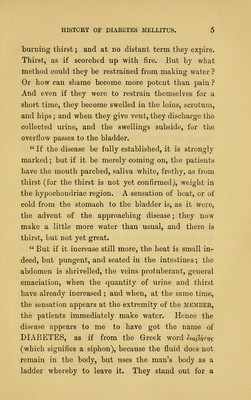
![burning thirst; and at no distant term they expire. Thirst, as if scorched up with fire. But by what method could they be restrained from making water ? Or how can shame become more potent than pain ? And even if they were to restrain themselves for a short time, they become swelled in the loins, scrotum, and hips; and when they give vent, they discharge the collected urine, and the swellings subside, for the oversow passes to the bladder. If the disease be fully established, it is strongly marked; but if it be merely coming on, the patients have the mouth parched, saliva white, frothy, as from thirst (for the thirst is not yet confirmed), weight in the hypochondriac region. A sensation of heat, or of cold from the stomach to the bladder is, as it were, the advent of the approaching disease; they now make a little more water than usual, and there is thirst, but not yet great. But if it increase still more, the heat is small in- deed, but pungent, and seated in the intestines; the abdomen is shrivelled, the veins protuberant, general emaciation, when the quantity of urine and thirst have already increased ; and when, at the same time, the sensation appears at the extremity of the member, the patients immediately make water. Hence the disease appears to me to have got the name of DIABETES, as if from the Greek word ^iapi]rriQ (which signifies a siphon), because the fluid does not remain in the body, but uses the man's body as a ladder whereby to leave it. They stand out for a](https://iiif.wellcomecollection.org/image/b21068124_0023.jp2/full/800%2C/0/default.jpg)