Volume 1
Chambers's Information for the people / edited by William and Robert Chambers.
- Date:
- 1848-1849
Licence: Public Domain Mark
Credit: Chambers's Information for the people / edited by William and Robert Chambers. Source: Wellcome Collection.
41/824 page 31
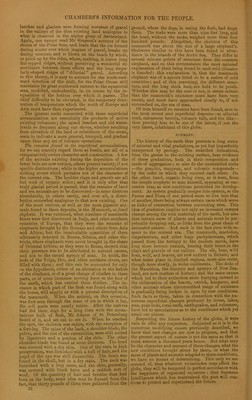
![race1 His entire frame was an apparatus of colossal mechanism, adapted exactly to the work it had to do; strong and ponderous, in proportion as this work was heavy and calculated to be the vehicle of life and en- ioyment to a gigantic race of quadrupeds, which, though they have ceased to be counted among the living inha- bitants of our planet, have, in their fossil bones, left behind them imperishable monuments of the consum- mate skill with which they were constructed.” _ _ Associated in the same set of deposits that is, in detrital beds of somewhat later origin than the ter- tiaries of Europe—Mr Darwin has discovered in South America the remains of several gigantic quadrupeds besides those of the megatherium. Of these, the most remarkable are—the Megalonyx, nearly allied to tho megatherium; the Scclidotherium, an animal as large as the” rhinoceros, but partaking of the character of the Cape ant-eaters and armadillos; another great arma- dillo-like animal with a bony covering; the Macraucli- enia, a huge beast, with a long neck like a camel; and the Toxodon, perhaps the strangest animal ever dis- covered. The macrauchenia is described as belonging to the same division of the pachydermata as the rhino- ceros and tapir, but showing in the structure of its long neck a clear relation to the camel, or rather to the alpaca and llama. As to the toxodon, it equalled in size the elephant or megatherium; but the structure of its teeth proves indisputably that it was intimately related to the gnawers, the order which, at the present day, includes most of the smallest quadrupeds. In many details it is allied to the thick-skinned animals; and, judging from the position of its eyes, ears, and nostrils, it was probably aquatic, like the dugong and manatee, to which it is also allied, “ How wonder- fully,” remarks the discoverer, “ are the different orders, at the present time so well separated, blended together in different parts of the structure of the toxodon! ” SUPERFICIAL ACCUMULATIONS. After the deposition of the tertiary strata, a great change took place in the relative distribution of land and ocean. Most parts of Europe, America, and the other continents were elevated above the waters; other regions seem to have been submerged, and an arrange- ment of physical conditions established not differing widely from those now existing. But these new con- ditions did not for an instant arrest the degrading and transporting power of water, the wasting effects of the atmosphere, the disturbing efforts of volcanoes, or the progressive development of organic life: the same agents which had exerted themselves, from the beginning of time, in modifying the physical features of the world, continued their career, only differing in power and degree according to this new arrangement. Thus accu- mulations of sand, gravel, clay, vegetable and animal matter, took place above the previously deposited strata —every river, lake, sea-shore, shell-bed, coral-reef, and peat-moss, contributing its peculiar quota. The term Superficial Accumulations is applied to these loosely- aggTegated masses of matter—whatever be their com- position or mode of formation—to distinguish them from the tertiary sands and clays, in all of which stra- Tifcatwn is distinct and undeniable. Other designa- tions have been proposed; but most of them arc objec- tionable, on the ground of involving theoretic opinions as to the time and origin of the deposits. The follow- ing synopsis exhibits both the nature of the accumu- lations, and the agencies concerned in their asjrre- gation:— Agencies. Nature of Accumulations. jiKTrit- ( Erratic lilocks or boulders ; dark tenneious clays. TAc. j Ossiferous gravels, sands, and pebbly clays. ( Ossiferous caves, fissures, and brcccin. j Haiaeil or nnclcnt benches; submarine forests. marine.-' Marino silt, sand-drift, shingle benches, Ac. ; ““marine deposits and accumulations. I ';rr;u’(:-(l(’jK]Sits on valloy sides, marking successive tit l. S ■,rMI?tt'r''evu'B>ani'<'ist*nct from general oceanic levels. • 1 \ alley deposits, consisting of river sand, gravel ,Ril fc, Ac. t Deltoid or estuary deposits, ancient and progressive. Agencies. Nature of Accumulations. Sites of ancient lakes now silted up with various debris, Marls—such as shell, clay, and calcareous marls. Lacustrine silt, and accumulations now in progress. Calcareous—calc-tuff, sinter, travertine, stalactites, and stalagmites. Siliceous and aluminous deposits from springs, Ac. Saline and sulphurous deposits from springs, from the sea, volcanoes, Ac. Bituminous exudations, pitch lakes, Arc. Vegetable—peat-mosses, jungles, vegetable drift. Animal—shell-beds, coral-reefs, Ac. Soils—primitive earths, with admixtures of organ- ised matter. Earthquakes—elevations and depressions, caused by vol- J Volcanoes—elevations, disruptions, and other changes canic. j caused by f Discharges and nccumulationsof lava, scoriae, dust, Ac. The above synopsis comprises all masses of matter which produce any sensible modification of the earth’s surface; other accumulations than these must be of a very local and limited description. All these masses are, moreover, of obvious formation, and are either still in progress of accumulation, or have been accumulated since the Tertiary era ; that is, since our planet assumed its present superficial aspect, and relative distribution of land and sea, or nearly so. On this account they may be designated “Formations of the Current Era,” none of them presenting much difficulty of solution, with the exception, perhaps, of the Erratic Block or Boulder Group; the others have been already noticed under the head of modifying causes. The boulder formation, or diluvial drift, consists, as stated, of a thick mass of dark tenacious clay, which overlies extensive districts, intermingled with nume- rous boulders having a rounded and water-worn ap- pearance. There is nothing like regularity of deposit in the mass, unless it may be said that it attains the greatest thickness and uniformity of composition on extensive plateaus like those of the coal measures, at the eastern extremity of certain valleys, and on the south-eastern flank of hills belonging to the secondary period. The clay is generally of a dark-blue colour, though in some localities it assumes a reddish hue. There are few lines of lamination in the mass, and no appearances of regular stratification, unless in some districts where there is a sort of natural division into “upper and lower clays”—the lower being dark and more compact, the upper lighter in the hue, and sepa- rated from the other by a thin reddish streak. Waiv- ing these minutiae, the whole may be described as a covering of compact dark clay, from 10 to 120 feet in thickness, full of boulders and rolled stones, from the size of an egg to many tons in weight; these blocks occupying the bottom, middle, or surface of the mass, without regard to gravity or any other law of arrange- ment. The boulders are principally of primitive rocks, the more friable strata of the secondary measures being less capable of resisting the drifting action to which the mass has evidently been subjected, and which in all cases appears to have passed in a direction from north-west to south-east. To account for this deposit, many theories have been advanced; but the one chiefly worthy of notice is that which supposes that those portions of Europe now covered with erratic blocks were submerged after the deposition of the stratified formations ; that this sub- mergence was caused by some extraordinary revolution in the planetary relations of our earth ; that it was accompanied by a change of climate, and other terres- trial conditions; that while in this state icebergs and avalanches formed around the earlier mountains which were still left above water; and that these icebergs, as they were . loosened from tho shore by the hcat°of summer, and floated southward by the currents of the ocean, dropped their burden of boulders and gravel precisely as Captain Scoresby found modern icebergs dropping their debris in the northern seas, and as the officers of the recent antarctic expedition observed similar phenomena in the Southern Polar Ocean. It is further supposed, that while icebergs distributed the erratic blocks and other debris in deep waters, ava- 31 LACUS- TRINE. MINE- RAL AND; CHEMI- CAL.](https://iiif.wellcomecollection.org/image/b22012400_0001_0041.jp2/full/800%2C/0/default.jpg)