On a new case of the interference of light / by the Rev. Baden Powell.
- Baden Powell
- Date:
- 1848
Licence: Public Domain Mark
Credit: On a new case of the interference of light / by the Rev. Baden Powell. Source: Wellcome Collection.
16/16
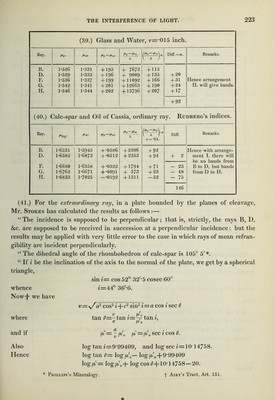
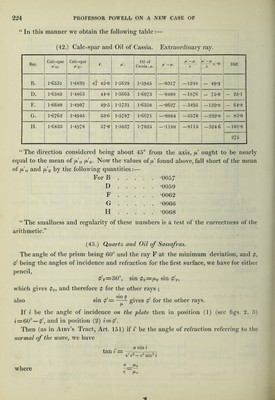
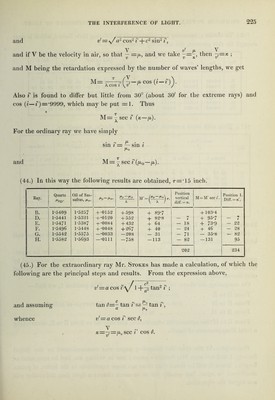
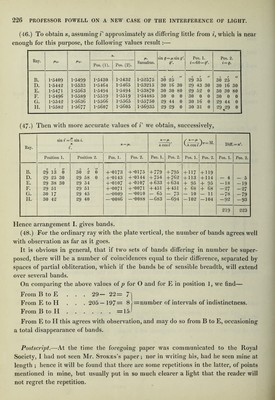
![(46.) To obtain x, assuming approximately as differing little from /, which is near enough for this purpose, the following values result:— Ray. K, sin Pos. 1. Pos. 2. i“o- Pos. (1). Pos. (2). Sassafras. i=60-(p'. i = ^ B. ]'5409 1-5499 1-5430 1-5432 1-52575 0 t ti 30 25 0 / // 29 35 0 / // 30 25 D. 1-5442 1-55.33 1 -5464 1-5465 1-53215 30 16 30 29 43 30 30 16 30 E. 1-5471 1-5563 1-5494 1-5494 1-53870 30 30 80 29 52 0 30 30 80 F. 1-5496 1-5589 1-5519 1-5519 1-54485 30 0 0 30 0 0 30 0 0 G. 1-5542 1-5636 1-5566 1-5565 1-55750 29 44 0 30 16 0 29 44 0 H. 1-5582 1-5677 1-5607 1-5605 1-56935 29 29 0 30 31 0 29 29 0 (47.) Then with more accurate values of /' we obtain, successively. Ray. sin t = X U. . ~ Sin 1. K K — K — fJt. K COS i VA. cos i' )r=M. Diff. = n\ Position 1. Position 2. Pos. 1. Pos. 2. Pos. 1. Pos. 2. Pos. 1. Pos. 2. Pos. 1. Pos. 2. B. 0 / // 29 13 0 0 / 30 2 // 0 + •0173 + -OI75 + 779 + 795 + 117 + 119 D. 29 25 30 29 58 0 + -0143 + -0144 + 754 + 762 + 113 + 114 — 4 — 5 E. 29 38 30 29 54 + -OIO7 + '0107 + 633 + 634 + 95 + 95 -18 -19 F. 29 51 29 51 + -OO7I + -OO7I + 451 + 451 + 68 + 68 -27 -27 G. 30 17 29 45 --OOO9 -•0010 — 65 - 73 — 10 — 11 -78 -79 H. 30 42 29 40 --0086 — •0088 -683 -694 -102 — 104 -92 -93 219 223 Hence arrangement I. gives bands. (48.) For the ordinary ray with the plate vertical, the number of bands agrees well with observation as far as it goes. It is obvious in general, that if two sets of bands differing in number be super- posed, there will be a number of coincidences equal to their difference, separated by spaces of partial obliteration, which if the bands be of sensible breadth, will extend over several bands. On comparing the above values oi p for O and for E in position 1, we find— From B to E . . . 29— 22= 7l From E to H . . . 205 — 197= 8 =number of intervals of indistinctness. From B to H =15J From E to H this agrees with observation, and may do so from B to E, occasioning a total disappearance of bands. Postscript.—At the time the foregoing paper was communicated to the Royal Society, I had not seen Mr. Stokes’s paper; nor in writing his, had he seen mine at length ; hence it will be found that there are some repetitions in the latter, of points mentioned in mine, but usually put in so much clearer a light that the reader will not regret the repetition.](https://iiif.wellcomecollection.org/image/b28754189_0018.jp2/full/800%2C/0/default.jpg)
 No text description is available for this image
 No text description is available for this image
 No text description is available for this image