The evolution of the elephant : as illustrated in the Yale collections / by Richard S. Lull.
- R. S. Lull
- Date:
- [1908]
Licence: In copyright
Credit: The evolution of the elephant : as illustrated in the Yale collections / by Richard S. Lull. Source: Wellcome Collection.
Provider: This material has been provided by The Royal College of Surgeons of England. The original may be consulted at The Royal College of Surgeons of England.
26/50 (page 22)
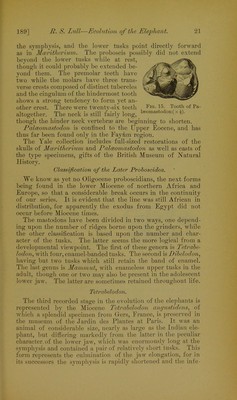
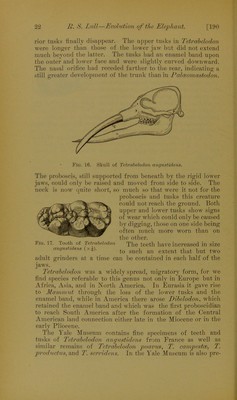
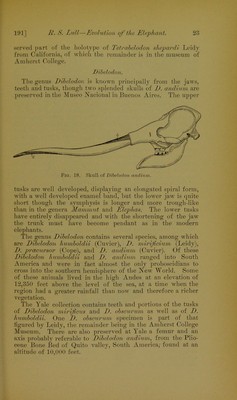
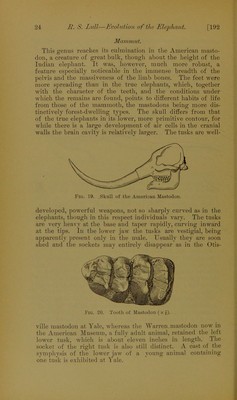
![rior tusks finally disappear. The upper tusks in Tetrabelodon were longer than those of the lower jaw but did not extend much beyond the latter. The tusks had an enamel band upon the outer and lower face and were slightly curved downward. The nasal orifice had receded farther to the rear, indicating a still greater development of the trunk than in Paloeomastodon. Fig. 16. Skull of Tetrabelodon cingustidens. The proboscis, still supported from beneath by the rigid lower jaws, could only be raised and moved from side to side. The neck is now quite short, so much so that were it not for the proboscis and tusks this creature could not reach the ground. Both upper and lower tusks show signs of wear which could only be caused by digging, those on one side being often much more worn than on the other. The teeth have increased in size to such an extent that but two adult grinders at a time can be contained in each half of the Fig. 17. Tooth of Tetrabelodon anguslidens ( x J). ]aws. Tetrabelodon was a widely spread, migratory form, for we find species referable to this genus not only in Europe but in Africa, Asia, and in North America. In Eurasia it gave rise to Mammut through the loss of the lower tusks and the enamel band, while in America there arose Dibelodon, which retained the enamel band and which was the first proboscidian to reach South America after the formation of the Central American land connection either late in the Miocene or in the early Pliocene. The Yale Museum contains fine specimens of teeth and tusks of Tetrabelodon angustidens from France as well as similar remains of Tetrabelodon poatms, T. campestie, T. productus, and T. serridens. In the Yale Museum is also pre-](https://iiif.wellcomecollection.org/image/b22410089_0028.jp2/full/800%2C/0/default.jpg)