Malaria, influenza and dengue / by Julius Mannaberg [and] O. Leichtenstern ; ed., with additions by Ronald Ross, J.W.W. Stephens and Albert S. Grünbaum ; Auth. tr. from the German, under the editorial supervision of Alfred Stengle.
- Mannaberg, Julius, 1860-1941.
- Date:
- 1905
Licence: Public Domain Mark
Credit: Malaria, influenza and dengue / by Julius Mannaberg [and] O. Leichtenstern ; ed., with additions by Ronald Ross, J.W.W. Stephens and Albert S. Grünbaum ; Auth. tr. from the German, under the editorial supervision of Alfred Stengle. Source: Wellcome Collection.
Provider: This material has been provided by the Francis A. Countway Library of Medicine, through the Medical Heritage Library. The original may be consulted at the Francis A. Countway Library of Medicine, Harvard Medical School.
39/830 (page 27)
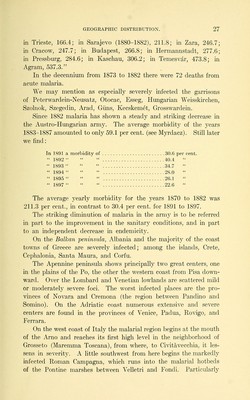
![in Trieste, 166.4; in Sarajevo (1880-1882), 211.8; in Zara, 246.7; in Cracow, 247.7; in Budapest, 266.8; in Hermannstadt, 277.6; in Pressburg, 284.6; in Kaschau, 306.2; in Temesvar, 473.8; in Agram, 537.3. In the deeennium from 1873 to 1882 there were 72 deaths from acute malaria. We may mention as especially severely infected the garrisons of Peterwardein-Neusatz, Otocac, Esseg, Hungarian Weisskirchen, Szolnok, Szegedin, Arad, Giins, Kecskemet, Grosswardein. Since 1882 malaria has shown a steady and striking decrease in the Austro-Hungarian army. The average morbidity of the years 1883-1887 amounted to only 59.1 per cent, (see Mjrdacz). Still later we find: In ] 891 a morbidity of 30.6 per cent. 1892 1893 1894 1895 1897 .40.4 .34.7 .28.0 .26.1 .22.6 The average yearly morbidity for the years 1870 to 1882 was 211.3 per cent., in contrast to 30.4 per cent, for 1891 to 1897. The striking diminution of malaria in the army is to be referred in part to the improvement in the sanitary conditions, and in part to an independent decrease in endemicity. On the Balkan peninsula, Albania and the majority of the coast towns of Greece are severely infected; among the islands, Crete, Cephalonia, Santa Maura, and Corfu. The Apennine peninsula shows principally two great centers, one in the plains of the Po, the other the western coast from Pisa down- ward. Over the Lombard and Venetian lowlands are scattered mild or moderately severe foci. The worst infected places are the pro- vinces of Novara and Cremona (the region between Pandino and Somino). On the Adriatic coast numerous extensive and severe centers are found in the provinces of Venice, Padua, Rovigo, and Ferrara. On the west coast of Italy the malarial region begins at the mouth of the Arno and reaches its first high level in the neighborhood of Grosseto (Maremma Toscana), from where, to Civitavecchia, it les- sens in severity. A little southwest from here begins the markedly infected Roman Campagna, which runs into the malarial hotbeds of the Pontine marshes between Velletri and Fondi. Particularly](https://iiif.wellcomecollection.org/image/b21171828_0039.jp2/full/800%2C/0/default.jpg)