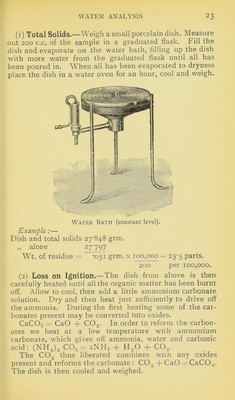
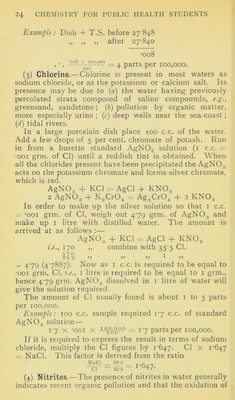
A manual of practical chemistry for public health students : especially arranged for those studying for the D.P.H / by A.W. Stewart.
- Alfred Walter Stewart
- Date:
- 1913
Licence: In copyright
Credit: A manual of practical chemistry for public health students : especially arranged for those studying for the D.P.H / by A.W. Stewart. Source: Wellcome Collection.
65/174
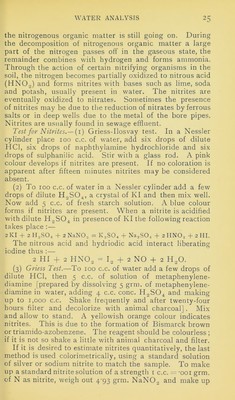
![the nitrogenous organic matter is still going on. During the decomposition of nitrogenous organic matter a large part of the nitrogen passes off in the gaseous state, the remainder combines with hydrogen and forms ammonia. Through the action of certain nitrifying organisms in the soil, the nitrogen becomes partially oxidized to nitrous acid (HNOo) and forms nitrites with bases such as lime, soda and potash, usually present in water. The nitrites are eventually oxidized to nitrates. Sometimes the presence of nitrites may be due to the reduction of nitrates by ferrous salts or in deep wells due to the metal of the bore pipes. Nitrites are usually found in sewage effluent. Test for Nitrites.— (1) Griess-Ilosvay test. In a Nessler cylinder place 100 c.c. of water, add six drops of dilute HC1, six drops of naphthylamine hydrochloride and six drops of sulphanilic acid. Stir with a glass rod. A pink colour develops if nitrites are present. If no coloration is apparent after fifteen minutes nitrites may be considered absent. (2) To 100 c.c. of water in a Nessler cylinder add a few drops of dilute H2S04, a crystal of KI and then mix well. Now add 5 c.c. of fresh starch solution. A blue colour forms if nitrites are present. When a nitrite is acidified with dilute H2S04 in presence of KI the following reaction takes place :— 2KI + 2 H,S04 + 2 NaNO, = K,S04 + Na2S04 + 2 UNO., + 2 HI. The nitrous acid and hydriodic acid interact liberating iodine thus :— 2 HI -f 2 HN02 = I2 + 2 NO + 2 H20. (3) Gviess Test.—To 100 c.c. of water add a few drops of dilute HC1, then 5 c.c. of solution of metaphenylene- diamine [prepared by dissolving 5 grm. of metaphenylene- diamine in water, adding 4 c.c. cone. H2S04 and making up to 1,000 c.c. Shake frequently and after twenty-four hours filter and decolorize with animal charcoal]. Mix and allow to stand. A yellowish orange colour indicates nitrites. This is due to the formation of Bismarck brown or triamido-azobenzene. The reagent should be colourless ; if it is not so shake a little with animal charcoal and filter. If it is desired to estimate nitrites quantitatively, the last method is used colorimetrically, using a standard solution of silver or sodium nitrite to match the sample. To make up a standard nitrite solution of a strength 1 c.c. = -ooi grm. of N as nitrite, weigh out 4-93 grm. NaN02 and make up](https://iiif.wellcomecollection.org/image/b28110067_0065.jp2/full/800%2C/0/default.jpg)