Licence: Public Domain Mark
Credit: Prof. Flower on the skull of a beluga. Source: Wellcome Collection.
Provider: This material has been provided by The Royal College of Surgeons of England. The original may be consulted at The Royal College of Surgeons of England.
1/4 page 667
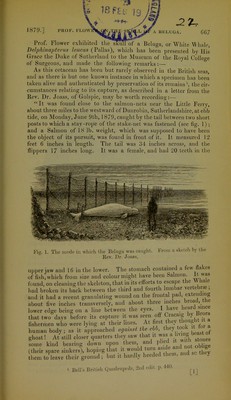
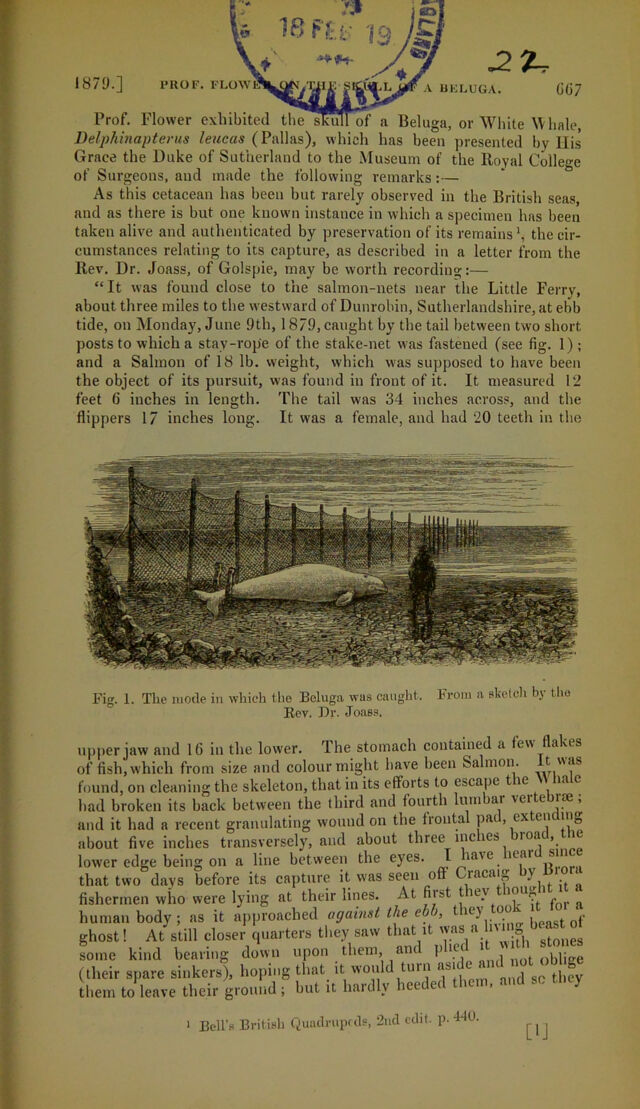
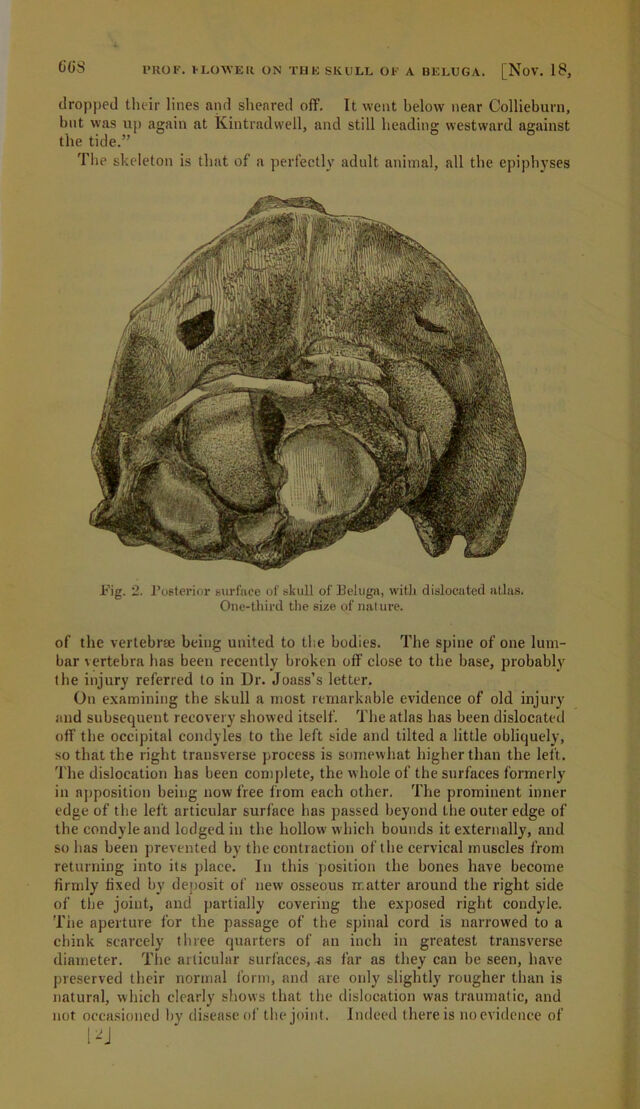
![1879.] PROF. FLOW -2£, VBKLUGA. GG7 Prof. Flower exhibited the skull of a Beluga, or White Whale, Delphinapterus leucas (Pallas), which has been presented by His Grace the Duke of Sutherland to the Museum of the Royal College of Surgeons, and made the following remarks:— As this cetacean has been but rarely observed in the British seas, and as there is but one known instance in which a specimen has been taken alive and authenticated by preservation of its remains1, tbe cir- cumstances relating to its capture, as described in a letter from the Rev. Dr. Joass, of Golspie, may be worth recording:— “It was found close to the salmon-nets near the Little Ferry, about three miles to the westward of Dunrobin, Sutherlandshire, at ebb tide, on Monday, June 9th, 1879, caught by the tail between two short posts to which a stay-rope of the stake-net was fastened (see fig. 1) ; and a Salmon of 18 lb. weight, which was supposed to have been the object of its pursuit, was found in front of it. It measured 12 feet 6 inches in length. The tail was 34 inches across, and tbe flippers 17 inches long. It was a female, and had 20 teeth in the Fig. 1. The mode in which the Beluga was caught. From a sketch by the Rev. Dr. Joass. upper jaw and 10 in the lower. The stomach contained a few flakes of fish, which from size and colour might have been Salmon. c ,ls found, on cleaning the skeleton, that in its efforts to escape the Whale had broken its hack between the third and fourth lum jar \ei e rae , and it had a recent granulating wound on the frontal pat, ex en mg about five inches transversely, and about three inches >oa >_ lower edge being on a line between the eyes. I have mar that two days before its capture it was seen off Cracaig y fishermen who were lying at their lines. At first t ey ion human body; as it approached against the eh>, t iej °o>' ghost! At still close.' quarters they saw that .t “ some kind bearing down upon them, and P \e, „11€i not obliee (their spare sinkers), hoping that it would tin n asi ' gR them to leave their ground ; but it hardly hee e i Bell’s British Quadrupeds, 2nd edit. p. 440. (^](https://iiif.wellcomecollection.org/image/b22455619_0003.jp2/full/800%2C/0/default.jpg)