Abstract of report on the origin and spread of typhoid fever in U.S. military camps during the Spanish war of 1898 / by Walter Reed ... Victor C. Vaughan ... and Edward O. Shakespeare.
- Surgeon General of the United States Army
- Date:
- 1900
Licence: Public Domain Mark
Credit: Abstract of report on the origin and spread of typhoid fever in U.S. military camps during the Spanish war of 1898 / by Walter Reed ... Victor C. Vaughan ... and Edward O. Shakespeare. Source: Wellcome Collection.
Provider: This material has been provided by the Augustus C. Long Health Sciences Library at Columbia University and Columbia University Libraries/Information Services, through the Medical Heritage Library. The original may be consulted at the the Augustus C. Long Health Sciences Library at Columbia University and Columbia University.
239/272 (page 211)
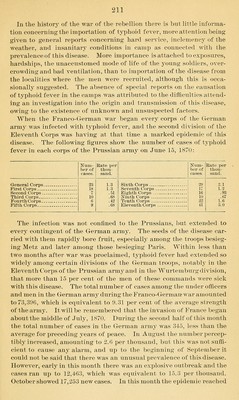
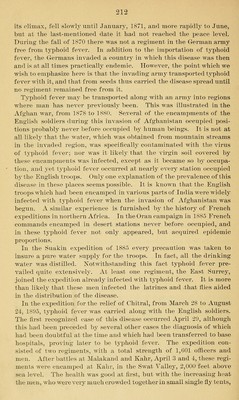
![In the history of the war of the rebellion there is but little informa- tion concerning the importation of typhoid fever, more attention being given to general reports concerning hard service, inclemency of the weather, and insanitary conditions in camp as connected with the prevalence of this disease. More importance is attached to exposures, hardships, the unaccustomed mode of life of the young soldiers, over- crowding and bad ventilation, than to imiDortation of the disease from the localities where the men were recruited, although this is occa- sionall}' suggested. The absence of special reports on the causation of typhoid fever in the camps was attributed to the difficulties attend- ing an investigation into the origin and transmission of this disease, owing to the existence of unknown and unsuspected factors. When the Franco-German war began every corps of the German army was infected with typhoid fever, and the second division of the Eleventh Corps was having at that time a marked e]3idemic of this disease. The following figures show the number of cases of typhoid fever in each corps of the Prussian army on June 15, 1870: General Corps First Corps ... Second Corps. Third Corps.. rourthCorps- Pifth Corps... Num- Rate per ber of thou- cases. sand. 33 1.3 18 1.3 r .51 10 .68 6 .43 9 .68 Sixth Corps Seventh Corps. Eighth Corps .. Ninth Corps .-. Tenth Corps _.. Eleventh Corps Num- ber of cases. Rate per thou- sand. 3.1 1.3 .93 .67 1.6 3.0 The infection was not confined to the Prussians, but extended to every contingent of the German army. The seeds of the disease car- ried with them rapidly bore fruit, especially among the troops besieg- ing Metz and later among those besieging Paris. Within less than two months after war was proclaimed, typhoid fever had extended so widely among certain divisions of the German troops, notably in the Eleventh Corps of the Prussian army and in the Wurtemburg division, that more than 15 per cent of the men of these commands were sick with this disease. The total number of cases among the under officers and men in the German army during the Franco-German-war amounted to 73,396, which is equivalent to 9.31 per cent of the average strength of the army. It will be remembered that the invasion of France began about the middle of July, 1870. During the second half of this month the total number of cases in the German army was 345, less than the average for preceding years of peace. In August the number percep- tibly increased, amounting to 2.6 per thousand, but this was not suffi- cient to cause any alarm, and up to the beginning of September it could not be said that there was an unusual prevalence of this disease. However, early in this month there was an explosive outbreak and the cases ran uj) to 12,463, which was equivalent to 15.3 per thousand. October showed 17,253 new cases. In this month the epidemic reached](https://iiif.wellcomecollection.org/image/b21230912_0239.jp2/full/800%2C/0/default.jpg)