Thirty-fourth annual report by the directors of James Murray's Royal Asylum for Lunatics, near Perth. June, 1861.
- James Murray's Royal Asylum for Lunatics
- Date:
- 1861
Licence: Public Domain Mark
Credit: Thirty-fourth annual report by the directors of James Murray's Royal Asylum for Lunatics, near Perth. June, 1861. Source: Wellcome Collection.
24/108 page 24
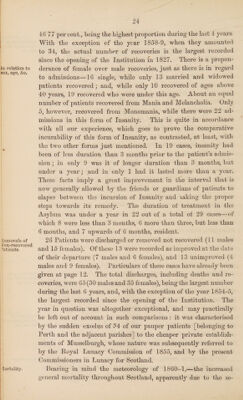
![in relation to sex, age, &c. Removals of 'Ton-recovered patients. [ortality. 46 77 per cent., being the highest proportion during the last 4 years. With the exception of the year 1858-9, when they amounted to 34, the actual number of recoveries is the largest recorded since the opening of the Institution in 1827. There is a prepon¬ derance of female over male recoveries, just as there is in regard to admissions—16 single, while only 13 married and widowed patients recovered; and, while only 10 recovered of ages above 40 years, 19 recovered who were under this age. About an equal number of patients recovered from Mania and Melancholia. Only 5, however, recovered from Monomania, while there were 22 ad¬ missions in this form of Insanity. This is quite in accordance with all our experience, which goes to prove the comparative incurability of this form of Insanity, as contrasted, at least, with the two other forms just mentioned. In 19 cases, insanity had been of less duration than 3 months prior to the patient’s admis¬ sion ; in only 9 was it of longer duration than 3 months, but under a year; and in only 1 had it lasted more than a year. These facts imply a great improvement in the interval that is now generally allowed by the friends or guardians of patients to elapse between the incursion of Insanity and taking the proper steps towards its remedy. The duration of treatment in the Asylum was under a year in 22 out of a total of 29 cases—of which 8 were less than 3 months, 6 more than three, but less than 6 months, and 7 upwards of 6 months, resident. 26 Patients were discharged or removed not recovered (11 males and 15 females). Of these 13 were recorded as improved at the date of their departure (7 males and 6 females), and 13 unimproved (4 males and 9 females). Particulars of these cases have already been given at page 12. The total discharges, including deaths and re¬ coveries, were 65 (30 males and 35 females), being the largest number during the last 6 years, and, with the exception of the year 1854-5, the largest recorded since the opening of the Institution. The year in question was altogether exceptional, and may practically be left out of account in such comparisons : it was characterised by the sudden exodus of 34 of our pauper patients [belonging to Perth and the adjacent parishes] to the cheaper private establish¬ ments of Musselburgh, whose nature was subsequently referred to by the Royal Lunacy Commission of 1855, and by the present Commissioners in Lunacy for Scotland. Bearing in mind the meteorology of 1860-1,—the increased general mortality throughout Scotland, apparently due to the se-](https://iiif.wellcomecollection.org/image/b30302262_0024.jp2/full/800%2C/0/default.jpg)



 No text description is available for this image
 No text description is available for this image
 No text description is available for this image