Sir Francis Drake and the Plymouth Corporation : supplementary facts and documents / by R.N. Worth.
- Richard Nicholls Worth
- Date:
- [1880?]
Licence: Public Domain Mark
Credit: Sir Francis Drake and the Plymouth Corporation : supplementary facts and documents / by R.N. Worth. Source: Wellcome Collection.
Provider: This material has been provided by The Royal College of Surgeons of England. The original may be consulted at The Royal College of Surgeons of England.
5/31 page 58
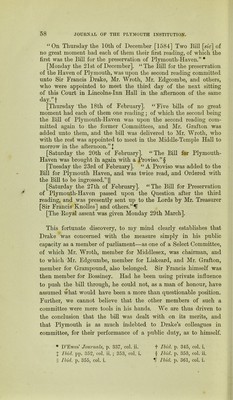
![“On Thursday the 10th of December [1584] Two Bill \sic\ of no great moment had each of them their first reading, of which the first was the Bill for the preservation of Plymouth-Haven.” * [Monday the 21st of December]. “The Bill for the preservation of the Haven of Plymouth, was upon the second reading committed unto Sir Francis Drake, Mr. Wroth, Mr. Edgcombe, and others, who were appointed to meet the third day of the next sitting of this Court in Lincolns-Inn Hall in the afternoon of the same day.^’t [Thursday'the 18th of February]. “Five bills of no great moment had each of them one reading; of which the second being the Bill of Plymouth-Haven was upon the second reading com- mitted again to the former Committees, and Mr. Grafton was added unto them, and the bill was delivered to Mr. Wroth, who with the rest was appointed to meet in the Middle-Temple Hall to morrow in the afternoon.”! [Saturday the 20th of February]. “The Bill for Plymouth- Haven was brought iii again with a Proviso. ”§ [Tuesday the 23rd of February]. “A Proviso was added to the Bill for Plymouth Haven, and was twice read, and Ordered with the Bill to be ingrossed.”]] [Saturday the 27th of February]. “The Bill for Preservation of Plymouth-Haven passed upon the Question after the third reading, and was presently sent up to the Lords by Mr. Treasurer [Sir Francis Knolles] and others. ”11 [The Eoyal assent was given Monday 29th March]. This fortunate discovery, to my mind clearly establishes that Drake was concerned with the measure simply in his public capacity as a member of parliament—as one of a Select Committee, of which Mr. Wroth, member for Middlesex, was chairman, and to which Mr. Edgcumbe, member for Liskeard, and Mr. Grafton, member for Grampound, also belonged. Sir Francis himself was then member for Bossiney. Had he been using private influence to push the bill through, he could not, as a man of honour, have assumed what would have been a more than questionable position. Further, we cannot believe that the other members of such a committee were mere tools in his hands. We are thus driven to the conclusion that the bill was dealt with on its merits, and that Plymouth is as much indebted to Drake’s colleagues in committee, for their ]Derformance of a public duty, as to himself. * D’Ewes’ Journals, p. 337, col. ii. t Ibid. p. 345, col. i. X Ibid. pp. 352, col. ii. ; 353, col. i. § Ibid. p. 353, col. ii. II Ibid. p. 355, col. i. II Ibid. ]). 361, col. i.](https://iiif.wellcomecollection.org/image/b22458566_0006.jp2/full/800%2C/0/default.jpg)