A theoretical and practical treatise on midwifery : including the diseases of pregnancy and parturition / by P. Cazeaux ; revised and annotated by S. Tarnier.
- Date:
- 1870
Licence: Public Domain Mark
Credit: A theoretical and practical treatise on midwifery : including the diseases of pregnancy and parturition / by P. Cazeaux ; revised and annotated by S. Tarnier. Source: Wellcome Collection.
Provider: This material has been provided by the Royal College of Physicians of Edinburgh. The original may be consulted at the Royal College of Physicians of Edinburgh.
58/1142 (page 54)
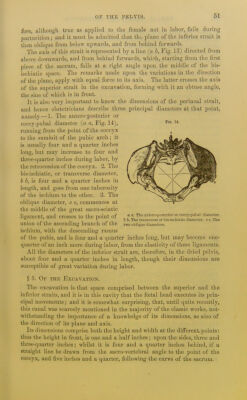
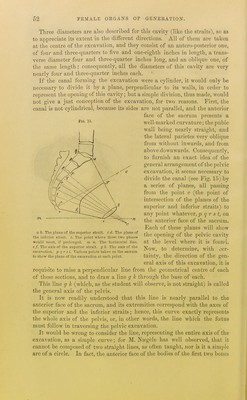
![nearly flat, and so much elevated that a horizontal line drawn from the superior part of the pubis would pass beneath the coccyx; the coxal bones are narrow, elongated, and nearly straight at their superior part, and the cartilasrinous iliac crests are not twisted. From this disposition it necessarily happens that the greatest diameter of the jielvis extends from the sacrum to the pubis. Burns declares that this form changes by degrees as the little girl advances in age: thus, the— Antpro-posterior diameter measures . Tranaverae diameter measures, . . . At 9 years. At 10 years. At 13 years. At 14 years. At IS years. 2% inches. 2^4 inches. 3}^ inches. 3 in. 5 lines. S'X Inches. 3J4 inches. 3% inches. 4 inclius. 3% inches. 4}^ inches. [3. According to Races. This subject, studied by Vrolick and Dubois, has been recently taken up by. Joulin, who published an important memoir on it, in which he proves that there is nothing characteristic in the differences to be observed in the pelves of the three races, Aryan, Negro, and Mongol; in the two latter espe- cially, the resemblance is so strong that it is impossible to distinguish them. The same author states that, contrary to what has been said, in all human races the transverse diameter of the superior strait is greater than the antero-posterior; but that the oblique diameter of the superior strait of the pelvis of the Negress and Mongol female differs from the traiwverse by a few millimeters only, whilst in the Arj'an female the difference amounts to a centimetre and a half. The pelves of the Negro and Mongol are, besides, less capacious than those of the white race; they have less depth, and the pubic arch is wider by several degrees.] § 8. Uses of the Pelvis. The pelvis constitutes the base of the trunk, and, according to Desor- meaux, it forms a complete ring, that may be reduced to two arches; the posterior and superior of which receives the whole weight of the trunk, whilst the anterior and inferior one serves as a buttress to it. The two lower extremities are attached to the lateral parts of this circle, and support, in the erect posture, all the weight of the superior part of the body. This use of the pelvis satisfactorily explains to the accoucheur the vicious forms the cavity often assumes when ossification is retarded, or when- ever any disease alters and softens the bones. Another function of the pelvis is to inclose and protect the bladder, rectum, and seminal vesicles of the male; the uterus. Fallopian tubes, and ovaries in the female. During gestation, it sustains and gives a proper direction to the womb; and in labor, it affords a passage to the child. ARTICLE IV. OP THE PELVIS, COVERED BY THE SOFT PARTS. It will not suffice to study the pelvis as found in the skeleton alone, for the changes produced in its form and dimensions in the living female, by the arrangement of the soft parts, also require our special attention.](https://iiif.wellcomecollection.org/image/b2198198x_0058.jp2/full/800%2C/0/default.jpg)