A theoretical and practical treatise on midwifery : including the diseases of pregnancy and parturition / by P. Cazeaux ; revised and annotated by S. Tarnier.
- Date:
- 1870
Licence: Public Domain Mark
Credit: A theoretical and practical treatise on midwifery : including the diseases of pregnancy and parturition / by P. Cazeaux ; revised and annotated by S. Tarnier. Source: Wellcome Collection.
Provider: This material has been provided by the Royal College of Physicians of Edinburgh. The original may be consulted at the Royal College of Physicians of Edinburgh.
67/1142 (page 63)
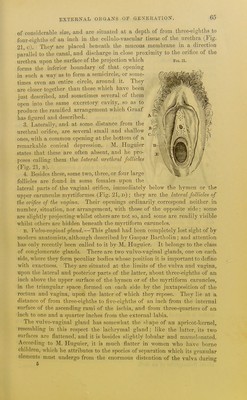
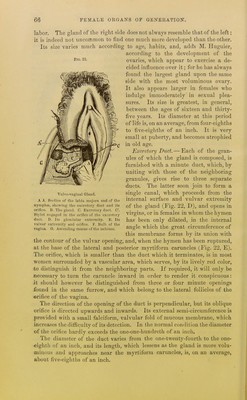
![The two forms just mentioned are not the only ones which the hymen may assume; other varieties have been described by M. Velpeau, as follows: 1. In the semicircular species, the hymen may form such a narrow and solid fold as to permit copulation without being ruptured. 2. In the cres- centic variety (Fig-19) the concave border approaches more or less towards the urethra, in such a way as to contract the vagina behind, and hence it almost always gives way in coition. 3. In the circular variety, the free border is much thinner than the other (Fig. 20), often being fringed, as it were, and leaving an opening which is sometimes round, sometimes slightly elongated, though in general situated somewhat nearer to the anterior than the posterior wall of the vagina. 4. Again, we find a disk or complete diaphragm, that is ordinarily pierced by a number of small holes like those of a watering-pot, and at other times is without the least aperture. 5. In some instances a species of bridle, or a small cord attached under the urethra, or on the concave border of the hymen, supplants both the valve and the circle. 6. Lastly, a second hymen occasionally exists above the first. [Full details of the anatomy of this membrane may be found in the thesis of M. Ledru, defended before the Faculty of Medicine, Paris, 1855. The hymen is formed by a fold of the vaginal mucous membrane, between the layers of which are cellular tissue fibres, some muscular fibres, vessels, and nerve filaments.] This membrane is regarded as the seal of virginity; and yet, as just shown, it is often found after a fecundation; and, on the other hand, numer- ous causes besides coition may destroy it. It is generally ruptured at the first sexual approaches, and of its debris are formed two or three little tubercles, bearing the name of carimculce myrtiformes. The hymen is composed of a fold of mucous membrane, containing between its laminaj a few vessels and some areolar tissue. 7. The carunculcd myrtiformes are some little tubercles, two to five in number, which appear to be the debris of the ruptured hymen; the two most anterior ones, according to certain physiologists, appertain to the median columns of the vagina. In consequence of oft-repeated friction, these caruncles may inflame, degenerate, and even become the source of an abundant purulent discharge; they have been mistaken under such circumstances for syphilitic vegetations, and the patient subjected to anti-venereal treatment, which, at least, was useless. Personal cleanliness, and some of the vegeto-miueral lotions are usually sufficient to cause their disappearance. M. Velpeau has resorted, however, in some cases, to excision. 8. Fossa Navicularis.—This is a little depression, of half an inch only in extent, bounded behind by the fourchette, and in front by the convex border of the hymen. It, like the fourchette, formed, as before stated, by the junction of the inferior extremities of the labia majora, mostly disappears after delivery.](https://iiif.wellcomecollection.org/image/b2198198x_0067.jp2/full/800%2C/0/default.jpg)