The technology of bread-making : including the chemistry and analytical and practical testing of wheat, flour, and other materials employed in bread-making and confectionery / by William Jago and William C. Jago.
- William Jago
- Date:
- 1911
Licence: In copyright
Credit: The technology of bread-making : including the chemistry and analytical and practical testing of wheat, flour, and other materials employed in bread-making and confectionery / by William Jago and William C. Jago. Source: Wellcome Collection.
Provider: This material has been provided by The University of Leeds Library. The original may be consulted at The University of Leeds Library.
827/944 page 815
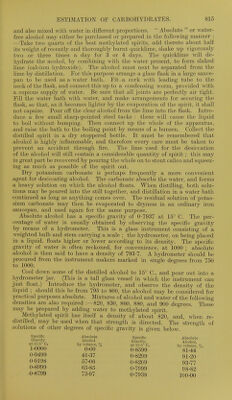
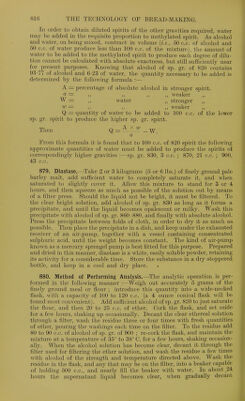
![iuicl also mixed with water in different jjroportions. “ Absolute ” or water- free alcohol may either be jnirchased or prepared in the following manner : — Take two quarts of the best methylated sj)irits, add thereto about half its ^\•eight of recently and thoroughly burnt quicldime, shake up vigorously two or three times a day for 3 or 4 days. The quicldime will de- hydrate the acohol, by combinmg with the water ]oresent, to form slaked lime (calcium hydroxide). The alcohol must next be separated from the lime by distillation. For this purpose arrange a glass flask in a large sauce- pan to be used as a water bath. Fit a cork with leading tube to the neck of the flask, and connect this up to a condensing worm, provided with a copious supply of water. Be sure that all joints are perfectly air tight. Fill the water bath with water, and make arrangements for securing the flask, so that, as it becomes lighter by the evaporation of the spirit, it shall not capsize. Pour off the clear alcohol from the lime into the flask. Intro- duce a few small shar]3-j)ointed steel tacks : these will cause the liquid to boil without bumping. Then connect up the whole of the apparatus, and raise the bath to the boiling point by means of a bunsen. Collect the •distilled spirit in a dry stoppered bottle. It must be remembered that alcohol is highly inflammable, and therefore every care must be taken to prevent an accident through fire. The lime used for the desiccation of the alcohol vdll still contain a considerable quantity of spirit ; this may in great part be recovered by pouring the whole on to stout calico and squeez- ing as much as possible of the spirit out. Dry potassium carbonate is perhaps frequently a more convenient agent for desiccating alcohol. The carbonate absorbs the water, and forms a heavy solution on which the alcohol floats. When distilling, both solu- tions may be poured into the stiU together, and distfllation in a water bath •continued as long as anything comes over. The residual solution of potas- sium carbonate may then be evaporated to dryness in an ordinary iron .saucepan, and used again for the same purpose. Absolute alcohol has a specific gravity of 0-7937 at 15° C. The per- centage of water is usually obtained by observing the specific gravity by means of a hydrometer. This is a glass instrument consisting of a weighted bulb and stem carrying a scale ; the hydrometer, on bemg jflaced in a liquid, floats higher or lower according to its density. The specific gravity of water is often reckoned, for convenience, at 1000 ; absolute alcohol is then said to have a density of 793-7. A hydrometer should be procured from the instrument makers marked in siugle degrees from 750 to 1000. Cool down some of the distilled alcohol to 15° C., and pour out into a hydrometer jar. (This is a tall glass vessel in which the instrument can just float.) Introduce the hydrometer, and observe the density of the liquid ; should this be from 795 to 800, the alcohol may be considered for practical purposes absolute. Mixtures of alcohol and water of the following densities are also required 820, 830, 860, 880, and 900 degrees. These may be jnepared by adding water to methylated spirit. Methylated spirit has itself a density of about 820, and, when re- distilled, may be used when that strength is directed. The strength of :solutions of other degrees of specific gravity is given below. Specific Absolute Specific Absolute Gravity at 15-5° C. Alcohol by voluir.e, % Gravity, at C. Alcohol, by volume. 1-0000 0-00 0-8599 81-44 0-9499 41-37 0-8299 91-20 0-9198 57-06 0-8209 93-77 0-8999 65-85 0-7999 98-82 0-8799 73-97 0-7938 100-00](https://iiif.wellcomecollection.org/image/b21538700_0827.jp2/full/800%2C/0/default.jpg)
 No text description is available for this image
 No text description is available for this image
 No text description is available for this image