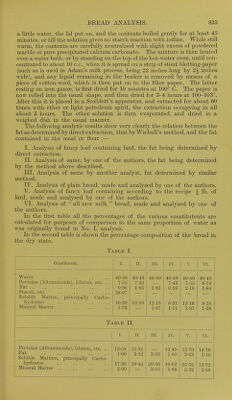
The technology of bread-making : including the chemistry and analytical and practical testing of wheat, flour, and other materials employed in bread-making and confectionery / by William Jago and William C. Jago.
- William Jago
- Date:
- 1911
Licence: In copyright
Credit: The technology of bread-making : including the chemistry and analytical and practical testing of wheat, flour, and other materials employed in bread-making and confectionery / by William Jago and William C. Jago. Source: Wellcome Collection.
Provider: This material has been provided by The University of Leeds Library. The original may be consulted at The University of Leeds Library.
852/944 page 840
![mation by Fehling’s solution. The most important point here is whether or not the sediment is practically free from soluble wheaten starch. In the discussion on the above paper, Bevan mentioned with approval a qualitative method devised by Wilson, and consisting of mixing the flour vdth clove oil, and examining with a ^ or ^-inch objective, Avhen the hilum of maize appears as a black dot or star, while wheaten and other starches are practically invisible. 913. Starch in Yeast.—^Bruylants and Druyts recommend the following method of estimating flour or starch in yeast : From 50 to 100 grams of the yeast are to be taken according to the suspected quantity of starch, and mixed thoroughly with a dilute solution of iodine in potassium iodide. The mixture is, if necessary, passed through a fine sieve in order to remove any large sized fragments of impurity. It is then allowed to settle, when the starch falls first, until the starch is covered by a thin layer of yeast. The yeasty liquid is poured away and this washing by decantation continued until only starch remains. A little fresh iodine must be added from time to time. The sediment is dissolved and converted into glucose by heating with dilute (2 per cent, hydrochloric acid), and then estimated in the usual manner. In tests made on yeasts containing known quantities of starch, ranging from 3 to 15 per cent., the amounts recovered by the method ranged between 96-7 per cent, and 100-8 per cent, of the added starch. [Bull. Assoc. Beige des CJiim., 13 [1] 20.) Instead of dissolving the starch obtained by this process in hydrochloric acid, it may be estimated direct by first washing with strong alcohol and then evaporating and drying in a tared dish. Comparative experiments should be made on yeasts to which knoAvn quantities of starch have been added. 914. Aniline Blue in Flour, Violette.—^Violette states that blue colourmg matter is sometimes employed in order to counteract the yellow tinge of flour. In order to detect such addition a sheet of white filter paper is floated on the surface of water, and a little of the suspected flour sprinkled thereon. In the presence of aniline colours, dark specks soon appear on the paper, which groAv in size and form blue spots. [Bull. 8oc. Chim., 1896, 15, 456). 915. Mineral Adulterants and Additions.—The presence or absence of most foreign mineral matters will have been indicated by the percentage of ash yielded. Alum is, however, added to flour in quantities too small to be thus detected. One of the most ready means of separating mineral substances from flour is by means of what is termed the 916. Chloroform Test.—^This test depends on the fact that chloroform has a density higher than that of the normal constituents of flour, but loAver than that of minerals generally ; consequently, on agitating a mixture of flour and chloroform, and then aUnAAong it to rest, the flour rises to the surface, and any mineral adulterants sink to the bottom. On the small scale, for the purpose of a qualitative test, a large dry test-tube may be about one-third fllled with the flour, then chloroform added to within one inch from the top. The tube must then be corked and violently shaken, after Avhich it must be alloAved to rest for some hours ; the mineral matter aa'A! then be found to have sunk to the bottom. For quantitatiA’-e purposes a glass “ separator ” is requisite. This is a cylindrical vessel some 2 inches in diameter, 8 or 10 inches in length, stoppered at the top, and furnished AAuth a stopcock at the bottom. Introduce m this vessel 100 grams of the flour and about 250 c.c. of methylated chloroform ; treat as directed for the smaller quantity. When tlie separation is effected, open the stojjcock and alloAV any sediment, Avith as little as possible of the liquid, to run through.](https://iiif.wellcomecollection.org/image/b21538700_0852.jp2/full/800%2C/0/default.jpg)
 No text description is available for this image
 No text description is available for this image
 No text description is available for this image