The technology of bread-making : including the chemistry and analytical and practical testing of wheat, flour, and other materials employed in bread-making and confectionery / by William Jago and William C. Jago.
- William Jago
- Date:
- 1911
Licence: In copyright
Credit: The technology of bread-making : including the chemistry and analytical and practical testing of wheat, flour, and other materials employed in bread-making and confectionery / by William Jago and William C. Jago. Source: Wellcome Collection.
Provider: This material has been provided by The University of Leeds Library. The original may be consulted at The University of Leeds Library.
899/944 page 887
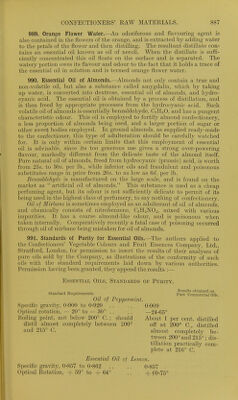
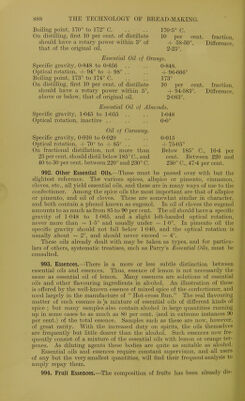
![989. Orange Flower Water.—^An odoriferous and flavouring agent is also contained in the flowers of the orange, and is extracted by adding water to the petals of the flower and then distilling. The resultant distillate con- tains an essential oil ImovTi as oil of neroh. When the distillate is suffi- ciently concentrated this oil floats on the surface and is separated. The v'atery portion owes its flavour and odour to the fact that it holds a trace of the essential oil in solution and is termed orange flower water. 990. Essential Oil of Almonds.—^Almonds not only contain a true and non-volatile oil, but also a substance called amygdalin, which by taking up water, is converted into dextrose, essential oil of almonds, and hydro- cyanic acid. The essential oil is obtained by a process of distillation, and is then freed by appropriate processes from the hydrocyanic acid. Such volatile oil of almonds is essentially benzaldehyde, CyHbO, and has a pungent characteristic odour. This oil is employed to fortify almond confectionery, a less proportion of almonds being used, and a larger portion of sugar or other sweet bodies employed. In ground almonds, as supplied ready-made to the confectioner, this type of adulteration should be carefully watched for. It is only vdthin certain limits that this employment of essentia] oil is advisable, since its too generous use gives a strong over-powering flavour, markedly different from the dehcate taste of the almond itself. Pure natural oil of almonds, freed from hydrocyanic (prussic) acid, is worth from 255. to 305. per lb., while inferior oils and fraudulent and poisonous substitutes range in price from 205. to as low as 6d. per lb. Benzaldehyde is manufactured on the large scale, and is found on the market as “ artificial oil of almonds.” This substance is used as a cheap perfuming agent, but its odour is not sufficiently delicate to permit of its being used in the highest class of perfumery, to Say nothing of confectionery. Oil of Mirhane is sometimes employed as an adulterant of oil of almonds, and chemically consists of nitrobenzene, C6HsN02, mixed with various impurities. It has a coarse almond-like odour, and is poisonous when taken internally. Comparatively recently a fatal case of poisoning occurred through oil of mirbane being mistaken for ofl. of almonds. 991. Standards of Purity for Essential Oils.—^The authors applied to the Confectioners’ Vegetable Colours and Fruit Essences Company, Ltd., Stratford, London, for permission to insert the results of their analyses of jDure oils sold by the Company, as illustrations of the conformity of such oils with the standard requirements laid do’wn by various authorities. Permission having been granted, they append the results :— Essential Oils, Standauds oe Purity. standard Requirements. Oil of Peppermint. Specific gravity, 0*900 to 0*920 Optical rotation, — 20° to — 30° .. Boiling point, not below 200° C. ; should distil almost completely between 200° and 215° C. Results obtained on Pure Commercial Oils. 0*909 -24*65° About 1 per cent, distilled off at 200° C., distilled almost completely be- tween 200° and 215°; dis- tillation practically com- plete at 216° C. Essential Oil of Lemon. Specific gravity, 0*857 to 0*862 .. .. 0*857 . Optical Rotation, -f 59° to -}- 64° .. -f 60*75°](https://iiif.wellcomecollection.org/image/b21538700_0899.jp2/full/800%2C/0/default.jpg)