Chenopodium oil. Pt. 2, The hydrocarbon fraction / by T.A. Henry and H. Paget.
- Thomas Anderson Henry
- Date:
- [1925.]
Licence: Public Domain Mark
Credit: Chenopodium oil. Pt. 2, The hydrocarbon fraction / by T.A. Henry and H. Paget. Source: Wellcome Collection.
13/16 (page 1659)
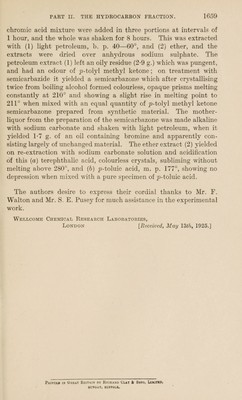
![chromic acid mixture were added in three portions at intervals of 1 hour, and the whole was shaken for 8 hours. This was extracted w'ith (1) light petroleum, b. p. 40—60°, and (2) ether, and the extracts were dried over anhydrous sodium sulphate. The petroleum extract (1) left an oily residue (2-9 g.) which was pungent, and had an odour of ^9-tolyl methyl ketone; on treatment with semicarbazide it yielded a semicarbazone which after crystallising twice from boiling alcohol formed colourless, opaque prisms melting constantly at 210° and showing a slight rise in melting point to 211° when mixed with an equal quantity of ^-tolyl methyl ketone semicarbazone prepared from synthetic material. The mother- liquor from the preparation of the semicarbazone was made alkaline with sodium carbonate and shaken with light petroleum, when it yielded T7 g. of an oil containing bromine and apparently con¬ sisting largely of unchanged material. The ether extract (2) yielded on re-extraction with sodium carbonate solution and acidification of this (a) terephthalic acid, colourless crystals, subliming without melting above 280°, and (b) ^-toluic acid, m. p. 177°, showing no depression when mixed with a pure specimen of p-toluic acid. The authors desire to express their cordial thanks to Mr. F. Walton and Mr. S. E. Pusey for much assistance in the experimental work. Wellcome Chemical Research Laboratories, London [Received, May 13th, 1925.] PuisTtB in Wheat Buitain by Richard Clat 4 Sons, Lisutsd, bcnoat, soefolk.](https://iiif.wellcomecollection.org/image/b30625282_0013.jp2/full/800%2C/0/default.jpg)