Chenopodium oil. Pt. 2, The hydrocarbon fraction / by T.A. Henry and H. Paget.
- Thomas Anderson Henry
- Date:
- [1925.]
Licence: Public Domain Mark
Credit: Chenopodium oil. Pt. 2, The hydrocarbon fraction / by T.A. Henry and H. Paget. Source: Wellcome Collection.
4/16 (page 1650)
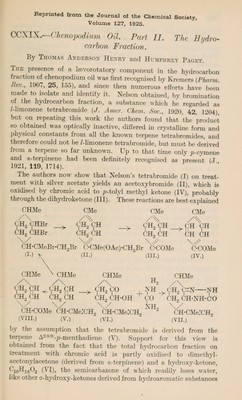
![(compare Manasse, Ber., 1897, 30, 668), forming a base, CnH17ON3 (VII). Further, the total hydrocarbon fraction on oxidation by permanganate yields a minute quantity of a substance, C9H140, which may be tetrahydro-p-tolyl methyl ketone (VIII). The substances C10H16O2 and C9H140 are not obtainable by the separate oxidation of any of the known components (p-cymene, a-terpinene, Z-limonene; see below) of the total hydrocarbon fraction, and it is consequently assumed that they come from the terpene * yielding the tetrabromide. The same formula has been used already for Tschugaeff’s iso- limonene (J. Russ. Rhys. Chem. Soc., 1904, 36, 988) and Aschan’s diprene (Annalen, 1924, 439, 221), neither of which has been fully described, and it is possible that further work may prove all three to be identical, in which, case the name Zsolimonene should have priority. It is of interest to note that all three occur along with limonene. The removal of the readily oxidisable components (a-terpinene and terpene A) by partial oxidation of the total hydrocarbon fraction with chromic acid leaves a mixture of p-cymene and the lsevorotatory component, the identity of which has been a subject of conjecture since 1907. On bromination followed by removal of the p-cymene, which inhibits crystallisation, Z-limonene tetra¬ bromide was isolated in good yield and the presence of Z-limonene was confirmed bv the formation of its characteristic oxidation products, hydroxyterpenylie and laevulic acids. It is also shown that on oxidation by permanganate in acetone, Z-limonene yields an oily lactone acid, C9H1405, derived from a dihydroxy-dicarboxylic acid, C9H1606, for wdiich the constitution 0H*CHMe*CH2*CH2*CH[CH(0H)*C02H]*CH2*C02H is suggested, since it furnishes laevulic and acetic acids by oxidation * with chromic acid, fission taking place at C. This acid is closely related to two acids, CH2Ac-CH2*CHAc-CH2*C02H -> C02H-CH2*CH2-CH(C02H)*CH2*C02H, mentioned, without description, by Tiemann and Semmler (Ber., 1895, 28, 2150) as resulting from the oxidation of limonene erythritol. In the course of this work large quantities of the total hydro¬ carbon fraction of chenopodium oil have been worked up, and from the first runnings of these a few c.c. of a substance, which is probably sym-dimethylethylene oxide, C4H80, was isolated. * To save space, and to avoid further additions to the synonymy of terpenes, this component is referred to later as terpene A.](https://iiif.wellcomecollection.org/image/b30625282_0004.jp2/full/800%2C/0/default.jpg)