Chenopodium oil. Pt. 2, The hydrocarbon fraction / by T.A. Henry and H. Paget.
- Thomas Anderson Henry
- Date:
- [1925.]
Licence: Public Domain Mark
Credit: Chenopodium oil. Pt. 2, The hydrocarbon fraction / by T.A. Henry and H. Paget. Source: Wellcome Collection.
5/16 page 1651
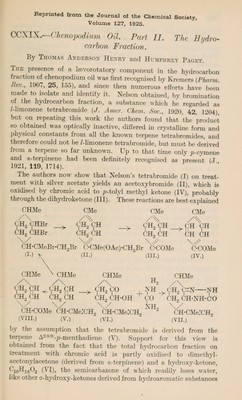
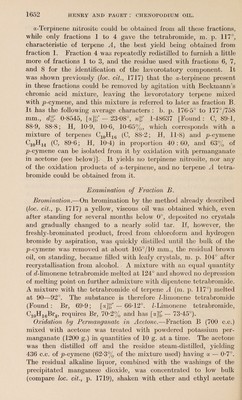
![.The following substances have now been identified as components of chenopodium oil. p-Cymene. st/m-Dimethylethylene oxide (?). Ascaridole. a-Terpinene. Butyric acid. Ascaridole glycol. A2 8,9?p-Menthadiene. Methyl salicylate. Ascaridole glycol J-Limonene. Salicylic acid. anhydride. The chief interest of chenopodium oil lies in its use as an anthel¬ mintic, and it is being employed on a large scale in anti-hookworm campaigns in various parts of the world. i)rs. Smillie and Pessoa, who have been engaged in researches on hookworm disease under the auspices of the Brazilian Government and the Rockefeller Foundation in Brazil, have kindly tested pharmacologically and clinically the chief components of chenopodium oil isolated in these laboratories, and their results have been published elsewhere (J. Pharm. Expt. Ther., 1924, 24, 359). They show that ascaridole, the chief component of the oil, is a remarkably efficient anthelmintic, and that none of the other constituents can be regarded as of value for this purpose. Experimental. When a receiver cooled in ice and salt was inserted during the separation of the hydrocarbon fraction from ascaridole by distillation at low pressure, a small amount of a colourless, volatile, pungent¬ smelling liquid was collected. On redistilling this, a little was obtained at 65—75°/760 ram., the greater part boiling between 120—170°, and consisting chiefly of terpenes and p-cymene. After drying over potassium carbonate, the lower-boiling fraction had b. p. 64—78°, 0-837, 0-8409, [a]}f + 0-10°, nf 1-3968 to 1-3981, M (vapour density) 70-2 (Found: C, 66-4; H, 12-4. C4HsO requires C, 66-7; H, 11-1%; 31, 72). The odour and the characters of this substance indicate that it might be one of the butylene oxides (possibly sym-dimethyl- ethylene oxide), b. p. 56—57; dJ 0-8344, but, as the figures given above show, the small quantity obtained was still highly impure. The hydrocarbon fraction distilled between 170 and 185°/760 mm. but all attempts to isolate fractions of constant boiling point failed; considerable separation was, however, effected by repeated slow distillation through a 12-bulb Young dephlegmator. Four litres of the hydrocarbon fraction so treated gave the following results : Fraction. 1 o MU 3 4 5 13• p« ••••••••• 170—174° 174° 174—175° 175—175-5° 175-5—176° Amount (g.) 20 40 150 1100 30 a (1-dcrn.) ... -14° -15° -16° -17° -17-5° Fraction. 6 7 8 9 13• p« •••••««•• 176—177° 177—178° O O ao 1 00 fH 180—184° Amount (g.) 800 800 900 150 a (I dem.) ... -18° -19° -20° -18-5°](https://iiif.wellcomecollection.org/image/b30625282_0005.jp2/full/800%2C/0/default.jpg)