Chenopodium oil. Pt. 2, The hydrocarbon fraction / by T.A. Henry and H. Paget.
- Thomas Anderson Henry
- Date:
- [1925.]
Licence: Public Domain Mark
Credit: Chenopodium oil. Pt. 2, The hydrocarbon fraction / by T.A. Henry and H. Paget. Source: Wellcome Collection.
6/16 page 1652
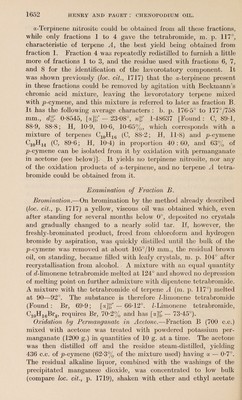
![a-Terpinene nitrosite could be obtained from all these fractions, while only fractions 1 to 4 gave the tetrabromide, m. p. 117°, characteristic of terpene A, the best yield being obtained from fraction 1. Fraction 4 was repeatedly redistilled to furnish a little more of fractions 1 to 3, and the residue used with fractions 6, 7, and 8 for the identification of the lsevorotatory component. It was showm previously {loc. cit., 1717) that the a-terpinene present in these fractions could be removed by agitation with Beckmann’s chromic acid mixture, leaving the lsevorotatory terpene mixed with p-cymene, and this mixture is referred to later as fraction B. It has the following average characters : b. p. 176-5° to 177°/758 mm., dg: 0-8545, [a]g° - 23-08°, nf 1-48637 [Found : C, 89-1, 88-9, 88-8; H, 10-9, 10-6, 10-65%, which corresponds with a mixture of terpenes C10H16 (C, 88-2; H, 11-S) and p-cymene C10H14 (C, 89-6; H, 10-4) in proportion 40 : 60, and 63% of p-cymene can be isolated from it by oxidation with permanganate in acetone (see below)]. It yields no terpinene nitrosite, nor any of the oxidation products of a-terpinene, and no terpene A tetra¬ bromide could be obtained from it. Examination of Fraction B. Bromination.—On bromination by the method already described {loc. cit., p. 1717) a yellow, viscous oil was obtained wdiich, even after standing for several months below 0°, deposited no crystals and gradually changed to a nearly solid tar. If, however, the freshly-brominated product, freed from chloroform and hydrogen bromide by aspiration, was quickly distilled until the bulk of the p-cymene was removed at about 105°/10 mm., the residual brown oil, on standing, became filled with leafy crystals, m. p. 104° after recrystallisation from alcohol. A mixture with an equal quantity of d-limonene tetrabromide melted at 124° and showed no depression of melting point on further admixture with dipentene tetrabromide. A mixture with the tetrabromide of terpene A (m. ji. 117°) melted at 90—92°. The substance is therefore Z-limonene tetrabromide (Found: Br, 69-9; [a]]f — 66-12°. Z-Limonene tetrabromide, Ci0Hi6Br4, requires Br, 70-2% and has [a% — 73-45°). Oxidation by Permanganate in Acetone.—Fraction B (700 c.c.) mixed with acetone was treated with powdered potassium per¬ manganate (1200 g.) in quantities of 10 g. at a time. The acetone was then distilled off and the residue steam-distilled, yielding 436 c.c. of p-cymene (62-3% of the mixture used) having a — 0-7°. The residual alkaline liquor, combined with the washings of the precipitated manganese dioxide, was concentrated to low bulk (compare loc. cit., p. 1719), shaken with ether and ethyl acetate](https://iiif.wellcomecollection.org/image/b30625282_0006.jp2/full/800%2C/0/default.jpg)