Instruction in chemical analysis : (Qualitative) / With a preface by Prof. Liebig. Edited by J.L. Bullock.
- Carl Remigius Fresenius
- Date:
- 1846
Licence: Public Domain Mark
Credit: Instruction in chemical analysis : (Qualitative) / With a preface by Prof. Liebig. Edited by J.L. Bullock. Source: Wellcome Collection.
33/412 page 11
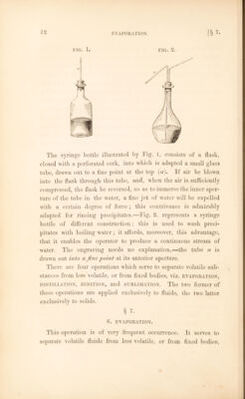
![DECANTATION. 1J § 6.] smooth filters and plaited filters : the former, in cases where the defiltrated solid substance is to he made use of; the latter, when we merely wish to clear the solution. Smooth filters are prepared by double folding of a circular piece of paper in such a manner, that the folds form right angles. The preparation of plaited filters is more properly a matter for ocular demonstration than for description. In very precise operations, the filters must not pro- ject over the brim of the funnel. It is in most cases advisable to moisten the filter previously to passing the fluid through it; since this not only tends to accelerate the process, hut it renders the solid particles less liable to pass through the pores of the filter. The paper selected for filters must he as free as possible from inorganic substances, especially from iron and lime. It is advisable always to keep two kinds, one of greater density for the separation of very finely-divided precipitates, and one of greater porosity for the speedy separation of grosser particles. The funnels must he either of glass or of porcelain. (§14. 10.) § 6. 5. DECANTATION. This operation is frequently resorted to instead of filtration, when the solid particles to he removed are of considerably greater specific gravity than the liquid in which they are suspended ; since, in that case, they will speedily subside to the bottom, rendering it easy, either to decant the supernatant liquid by simply inclining the vessel, or to remove it by means of a syphon. In cases where filtration or decantation are applied for the pur- pose of obtaining the solid substance, the latter must he freed, subsequently, by repeated washing from the liquid still adhering to it. This operation is also termed edulcoration or rinsing. The edulcoration of precipitates collected in a filter is usually effected by means of a syringe bottle, such as is represented by](https://iiif.wellcomecollection.org/image/b29300940_0033.jp2/full/800%2C/0/default.jpg)