A text-book of animal physiology : with introductory chapters on general biology and a full treatment of reproduction, for students of human and comparative (veterinary) medicine and of general biology / by Wesley Mills ... with over 500 illustrations.
- T. Wesley Mills
- Date:
- 1889
Licence: Public Domain Mark
Credit: A text-book of animal physiology : with introductory chapters on general biology and a full treatment of reproduction, for students of human and comparative (veterinary) medicine and of general biology / by Wesley Mills ... with over 500 illustrations. Source: Wellcome Collection.
Provider: This material has been provided by the Augustus C. Long Health Sciences Library at Columbia University and Columbia University Libraries/Information Services, through the Medical Heritage Library. The original may be consulted at the the Augustus C. Long Health Sciences Library at Columbia University and Columbia University.
169/750 page 137
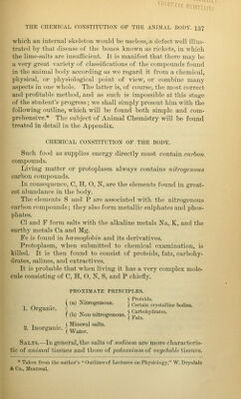
![whicli an internal skeleton would be useless, a defect well illus- trated by that disease of the bones known as rickets, in which the lime-salts are insufficient. It is manifest that there may be a very great variety of classifications of the compounds found in the animal body according as we regard it from a chemical, physical, or physiological point of view, or combine many aspects in one whole. The latter is, of course, the most correct and profitable method, and as such is impossible at this stage of the student's progress ; we shall simply present him with the following outline, which will be found both simjjle and com- prehensive.* The subject of Animal Chemistry will be found treated in detail in the Appendix. CHEMICAL CONSTITUTION OF THE BODY. Such food as supplies energy directly must contain carbon compounds. Living matter or protoplasm always contains nitrogenous carbon compounds. In consequence, C, H, O, IST, are the elements found in great- est abundance in the body. The elements S and P are associated with the nitrogenous carbon compounds; they also form metallic sulphates and phos- XJhates. CI and F form salts with the alkaline metals Na, K, and the earthy metals Ca and Mg. Fe is found in luemoglohin and its derivatives. Protoplasm, when submitted to chemical examination, is killed. It is then found to consist of proteids, fats, carbohy- drates, salines, and extractives. It is probable that when living it has a very complex mole> cule consisting of C, H, O, N, S, and P chiefly. PROXIMATE PRINCIPLES. 1 Or anic j ^^^ ^'*^*'^^^°^- ] Certain crystalline bodies. ° ■ I ,-,. TVT -i. S Carbohydrates. ( (b) Non-mtrogenous. •) xj^ ^. „ , .1 Mineral salts. 2. Inorganic. ^.^ I Water Salts.—In general, the salts of sodium are more characteris- tic of animal tissues and those of potassium of vegetable tissues. * Takf-ri from Iho iiuthor's Outlinesof Lectures on Physiology, W. Dry.sdalo & Co., Moritr«;ul.](https://iiif.wellcomecollection.org/image/b21212867_0169.jp2/full/800%2C/0/default.jpg)