A text-book of animal physiology : with introductory chapters on general biology and a full treatment of reproduction, for students of human and comparative (veterinary) medicine and of general biology / by Wesley Mills ... with over 500 illustrations.
- T. Wesley Mills
- Date:
- 1889
Licence: Public Domain Mark
Credit: A text-book of animal physiology : with introductory chapters on general biology and a full treatment of reproduction, for students of human and comparative (veterinary) medicine and of general biology / by Wesley Mills ... with over 500 illustrations. Source: Wellcome Collection.
Provider: This material has been provided by the Augustus C. Long Health Sciences Library at Columbia University and Columbia University Libraries/Information Services, through the Medical Heritage Library. The original may be consulted at the the Augustus C. Long Health Sciences Library at Columbia University and Columbia University.
183/750 page 151
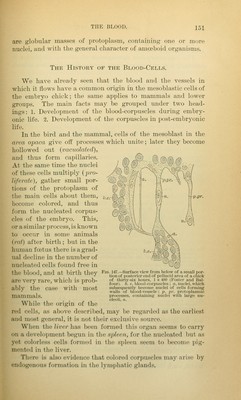
![are globular masses of protoplasm, containing one or more nuclei, and with the general character of amoeboid organisms. The History of the Blood-Cells. We have already seen that the blood and the vessels in which it flows have a common origin in the mesoblastic cells of the embryo chick; the same applies to mammals and lower groups. The main facts may be grouped under two head- ings: 1. Development of the blood-corpuscles during embry- onic life. 2. Development of the corpuscles in ]30st-embryonic life. In the bird and the mammal, cells of the mesoblast in the area opaca give off processes which unite; later they become hollowed out (vacuolated), and thus form capillaries. At the same time the nuclei of these cells multiply (pr-o- liferate), gather small por- tions of the protoplasm of the main cells about them, become colored, and thus form the nucleated corpus- cles of the embryo. This, or a similar process, is known to occur in some animals (rat) after birth; but in the human f cetus there is a grad- ual decline in the number of nucleated cells found free in the blood, and at birth they Fjg 147.-Surface view from below of a small por- ' •' tion of posterior end of pellucid^area of a cmck are very rare, which is prob- ably the case with most mammals. While the origin of the red cells, as above descfiljed, may be regarded as the earliest and most general, it is not their exclusive source. When the liver has been formed this organ seems to carry on a development begun in tlie spleen, for the nucleated but as yet colorless cells formed in the spleen seem to become pig- mented in the liver. There is also evidence that colored corjjuscles may arise by endogenous formation in the lymphatic glands. of thirty-six hours, 1 x 4()0 (Foster and Bal- four), h. c. lilood-corpuscles ; a, nuclei, which subsequently become nuclei of cells forming walls of Ijlood-vessels ; p. \)r. protoplasmic processes, containing nuclei with large nu- cleoli, >i.](https://iiif.wellcomecollection.org/image/b21212867_0183.jp2/full/800%2C/0/default.jpg)