A text-book of animal physiology : with introductory chapters on general biology and a full treatment of reproduction, for students of human and comparative (veterinary) medicine and of general biology / by Wesley Mills ... with over 500 illustrations.
- T. Wesley Mills
- Date:
- 1889
Licence: Public Domain Mark
Credit: A text-book of animal physiology : with introductory chapters on general biology and a full treatment of reproduction, for students of human and comparative (veterinary) medicine and of general biology / by Wesley Mills ... with over 500 illustrations. Source: Wellcome Collection.
Provider: This material has been provided by the Augustus C. Long Health Sciences Library at Columbia University and Columbia University Libraries/Information Services, through the Medical Heritage Library. The original may be consulted at the the Augustus C. Long Health Sciences Library at Columbia University and Columbia University.
187/750 page 155
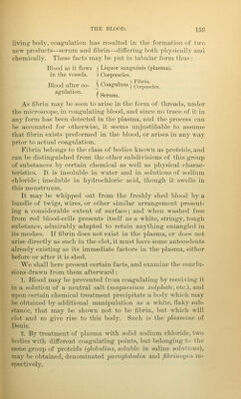
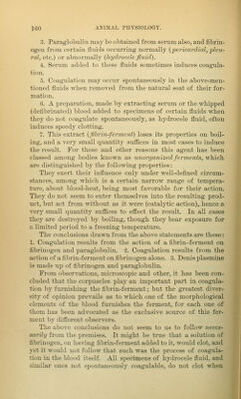
![ical and its chemical composition, to what extent is not exactly known, when removed from the body. Composition of Serum.—The liuid remaining after coagulation of the blood can, of course, be examined chemically with con- siderable thoroughness and confidence. By far the greater part of serum consists of water; thus, it has been estimated that of 100 parts the following statement will represent fairly well the proportional comj)osition: Water 90 parts; Proteids 8 to 9 Salines, fats, and extractives (small in quantity and not readily obtained free) 1 to 2 parts. The proteids are made up of two substances which can be distinguished by solubility, temperature at which coagulation occurs, etc., known as paraglohulin and serum-albumen, and which may exist in equal amount. It is not possible, of course, to say whether these substances exist as such in the living blood-plasma or not. The fats are very variable in quantity in serum, depend- ing on a corresponding variability in the plasma, in which they would be naturally found in greatest abundance after a meal. They exist as neutral stearin, palmitin, olein, and as soaps. The principal extractives found are urea, creatin, and allied bodies, sugar, and lactic acid. Serum in most animals contains more of sodium salts than the corpuscles, while the latter in man and some other mammals contain a preponderating quan- tity of potassium compounds. The princi^jal salts of serum are sodium chloride, sodium bi- carbonate, sodium sulphate, and phosphate in smaller quantity, as also of calcium and magnesium phosphate, with rather more of potassium chloride. It is highly probable that this proportion also represents moderately well the composition of plasma, which is, of course, from a ])]iysiological point f)f view, the important matter. The Composition of the Corpuscles.—Taken together, the differ- ent forms of blood-cells make up from one tliird to nearly one half the weight of the blood, and of this the red corpuscles may be considered as constituting nearly the whole. The coloi'less cells are known to contain fats and glycogen, which, with salts, we may boli(;ve exist in the living cells, and, in addition t«> the proteids, into which protoplasm resolves it-](https://iiif.wellcomecollection.org/image/b21212867_0187.jp2/full/800%2C/0/default.jpg)