A text-book of animal physiology : with introductory chapters on general biology and a full treatment of reproduction, for students of human and comparative (veterinary) medicine and of general biology / by Wesley Mills ... with over 500 illustrations.
- T. Wesley Mills
- Date:
- 1889
Licence: Public Domain Mark
Credit: A text-book of animal physiology : with introductory chapters on general biology and a full treatment of reproduction, for students of human and comparative (veterinary) medicine and of general biology / by Wesley Mills ... with over 500 illustrations. Source: Wellcome Collection.
Provider: This material has been provided by the Augustus C. Long Health Sciences Library at Columbia University and Columbia University Libraries/Information Services, through the Medical Heritage Library. The original may be consulted at the the Augustus C. Long Health Sciences Library at Columbia University and Columbia University.
189/750 page 157
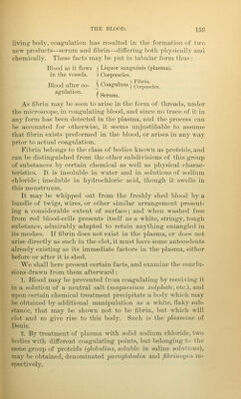
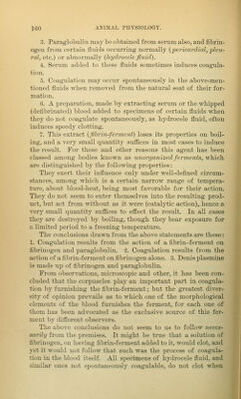
![to estimate the total quantity of blood in the body of an animal by bleeding is highly fallacious for various reasons. It is im- possible to withdraw all the blood from the vessels by merely opening even the largest of them, and, if it were, the original quantity would be augmented by fluid absorbed into them dur- ing the very act. No method has as yet been devised that is free from objection, hence the conclusions arrived at as to the total quantity of blood are not in accord; and in the nature of the case no accurate estimate can be made, but about one thir- teenth to one fourteenth may be taken as a fair average; so that in a man of one hundred and forty pounds weight there should be about ten pounds of blood; but, of course, this will vary with every hour of the day and will be greatest after a meal. As an example of the methods referred to, we give Welck- er's, which is briefly as follows: The animal is bled to death from the carotid; a sample of the defibrinated blood (1 cc.) is saturated with carbon monoxide (CO), which gives a perma- nent red color; this diluted with 500 cc. of water furnishes a standard sample. The blood-vessels of the animal are washed out with a G per cent solution of common salt, but the out- flowing stream is colorless; to this is added the fluid obtained by chopping up the tissues of the animal, steeping, washing out, and pressing. The whole is diluted to give the color of the standard solution, from which the amount of blood in this mixt- ure may be calculated, since every 500 cc. answers to 1 cc. of blood; the blood obtained by bleeding can, of course, be accu- rately measured. It would be slightly more accurate to make the diluted blood of the animal operated upon the standard without treat- ment with carbon monoxide. Such a method, though the best yet devised, is open to ob- jection also, as will occur to most readers. The relative quantities of blood in different parts of the body have been estimated to be as follows: Liver one fourth. Skeletal muscles Heart, lungs, large arteries, and veins. Other structures The significance of this distribution will appear later. The Coagulation of the Blood.—When blood is removed from it.s accu.storiied channels, it undergoes a marked chemical and ]>hysical change, termed clotting or coagulation. In the case of most vertebrates, almost as soon as the blood leaves the ves-](https://iiif.wellcomecollection.org/image/b21212867_0189.jp2/full/800%2C/0/default.jpg)