A text-book of animal physiology : with introductory chapters on general biology and a full treatment of reproduction, for students of human and comparative (veterinary) medicine and of general biology / by Wesley Mills ... with over 500 illustrations.
- T. Wesley Mills
- Date:
- 1889
Licence: Public Domain Mark
Credit: A text-book of animal physiology : with introductory chapters on general biology and a full treatment of reproduction, for students of human and comparative (veterinary) medicine and of general biology / by Wesley Mills ... with over 500 illustrations. Source: Wellcome Collection.
Provider: This material has been provided by the Augustus C. Long Health Sciences Library at Columbia University and Columbia University Libraries/Information Services, through the Medical Heritage Library. The original may be consulted at the the Augustus C. Long Health Sciences Library at Columbia University and Columbia University.
199/750 page 167
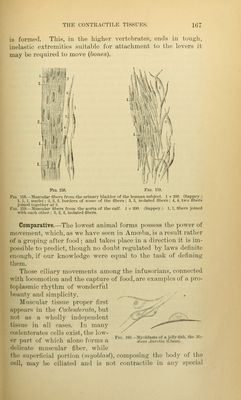
![is formed. This, in the higher vertebrates, ends in tough, inelastic extremities suitable for attachment to the levers it may be required to move (bones). Fio. 158. Fig. 159. Fig. 1.58.—Muscular fibers from the urinary bladder of the human subject. 1 x 200. (Sappey.) 1, 1,1, nuclei ; 2, 2, 2, borders of some of the fibers : 3, 3, isolated fibers ; 4, 4, two fibers joined together at 5. Fig. 1.59.—Muscular fibers from the aorta of the calf. 1 x 200. (Sappey.) 1, 1, fibers joined with each other ; 2, 2, 2, isolated fibers. Comparative.—The lowest animal forms possess the power of movement, which, as we have seen in Amoeba, is a result rather of a groping after food; and takes place in a direction it is im- possible to predict, though no doubt regulated by laws definite enough, if our knowledge were equal to the task of defining them. Those ciliary movements among the infusorians, connected with locomotion and the capture of food, are examples of a pro- toplasmic rhythm of wonderful beauty and simplicity. Muscular tissue proper first appears in the Codenteruta, but not as a wholly independent tissue in all cases. In many ffjelenterates colls exist, the low- •T part of which alone forms a delicate muscular fibei', wliilo the superficial portion (inijoblast), composing the body of the cell, may be ciliated and is not contractile in any s])ecial ■'■»=-?»».'}■ Fig. 100.—Myoblasts of a jelly-flsh, the 3/e- duHU Aurclia (Claus).](https://iiif.wellcomecollection.org/image/b21212867_0199.jp2/full/800%2C/0/default.jpg)